
Neohesperidin Dihydrochalcone Powder as a Natural Sweetener
November 18, 2026
Neohesperidin dihydrochalcone powder works as a natural-source sweetener because manufacturers make it from neohesperidin, a flavonoid found in bitter oranges and other citrus. It tastes about 1,500 to 1,800 times sweeter than sucrose, so a few parts per million can sweeten a drink while adding almost no calories. It also softens bitter and metallic notes when paired with other sweeteners. We at Kang Biotech see formulators choose it for its stability from pH 2 to 7 and its smooth, lasting sweetness. Whether a label may say "natural" depends on local rules, so buyers should confirm the claim for their market.
What Neohesperidin Dihydrochalcone Powder Is and Why It Draws Interest
Chemical Identity and Source
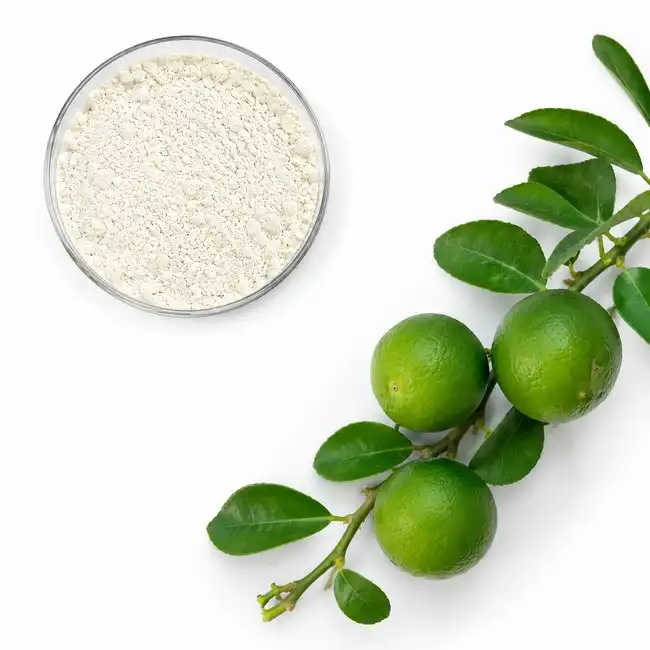
Neohesperidin dihydrochalcone, often shortened to NHDC, carries CAS No. 20702-77-6 and the molecular formula C28H36O15. Its molecular weight is about 612.58 g/mol, its EU number is E959, and its FEMA number is 3811. Producers make it by hydrogenating neohesperidin from citrus. We manage more than 20,000,000 m² of bitter orange plantations in Lianyuan, Hunan Province, and extract the material by water or ethanol extraction in our 33,000 m² facility. Our food-grade powder is white to off-white, assays at 98% by HPLC, and melts at 156–158°C. This traceable chain from plantation to drum gives auditors a clear starting point.
Sweetness Profile and Taste Behavior
NHDC does not behave like sugar on the tongue. Sweetness arrives slowly and lasts longer than sucrose, which many tasters describe as rounded rather than sharp. At higher levels, a cooling, licorice-like finish can appear, so formulators usually treat NHDC as part of a blend. A 2007 study in BMC Structural Biology described where NHDC binds the human sweet taste receptor. In practice, the slow onset fills the gap that fast-fading sweeteners leave and gives a drink more body. I suggest tasting prototypes at several time points, such as 5, 30, and 60 seconds, to catch the full curve.
Benefits for Sugar Reduction and Bitterness Masking
Three benefits bring most buyers to neohesperidin dihydrochalcone powder. It sweetens at ppm levels with very low caloric value, and it is non-cariogenic with negligible glycemic impact, which suits sugar-reduced, diabetic-friendly, and keto products. It softens the bitter and metallic notes that stevia and other high-intensity sweeteners can leave, and masking often needs only 1–5 ppm. It also blends well: pairing it with aspartame or acesulfame-K can raise total sweetness by up to 40%, according to supplier data, which can trim the second sweetener. Because some U.S. cities and other countries tax sugar-sweetened drinks, cutting sugar may also change tax exposure. Check local rules.
Where Neohesperidin Dihydrochalcone Powder Works: Applications, Solubility, and Dosage
Beverages and Dairy
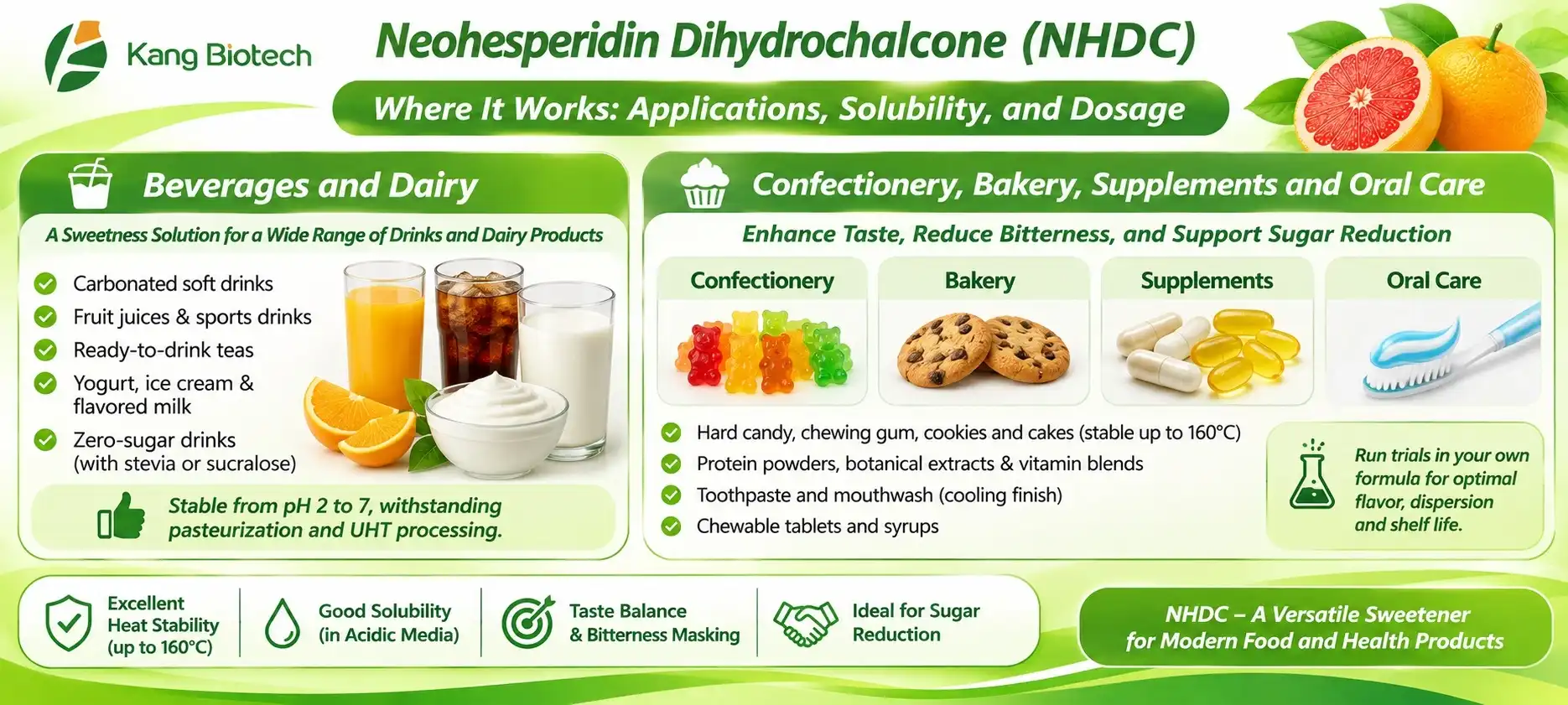
Beverage developers use NHDC in carbonated soft drinks, fruit juices, sports drinks, and ready-to-drink teas. Its stability from pH 2 to 7 suits acidic formulas, and it holds through pasteurization and UHT processing. In yogurt, ice cream, and flavored milk, it supports sugar reduction while keeping flavor steady in frozen storage. In zero-sugar drinks, a small amount added to a stevia or sucralose base can round out the body that high-intensity sweeteners often lack. Because every matrix differs, I recommend running bench samples in your actual formula, with real acids, flavors, and minerals, not plain water.
Confectionery, Bakery, Supplements, and Oral Care
Heat tolerance makes NHDC suitable for hard candy, chewing gum, cookies, and cakes, and our supplier data lists stability up to 160°C. Protein powders, botanical extracts, and vitamin blends often carry bitter notes that ppm-level NHDC can soften. Toothpaste and mouthwash makers use its cooling finish, and pharmaceutical teams consider it for chewable tablets and syrups. Pharmaceutical and regulated supplement projects need extra review of excipient suitability and local ingredient status before launch. For dry products, a trial should cover flavor, dispersion, and shelf life together.
Solubility and Dosage
Solubility is where many first trials go wrong. Neohesperidin dihydrochalcone powder dissolves poorly in cold water, at roughly 0.4 to 0.5 g/L, while solubility rises in hot water and in ethanol-water mixtures. Liquid plants commonly prepare a concentrated premix, dissolve it hot, and dose it into the batch. For dry mixes, pre-blending with a bulk carrier and sieving spreads the powder evenly. Supplier guidance points to about 10–50 ppm for sweetening and 1–5 ppm for bitterness masking, depending on the formula, so treat these as starting ranges. At 50 ppm, 1 kg would dose about 20 tonnes of finished product. Record temperature, stirring speed, final pH, and any haze or sediment over shelf life, and settle the final level through sensory panels and local maximum use levels.
Neohesperidin Dihydrochalcone Powder Compared with Other Sweeteners
Versus Stevia
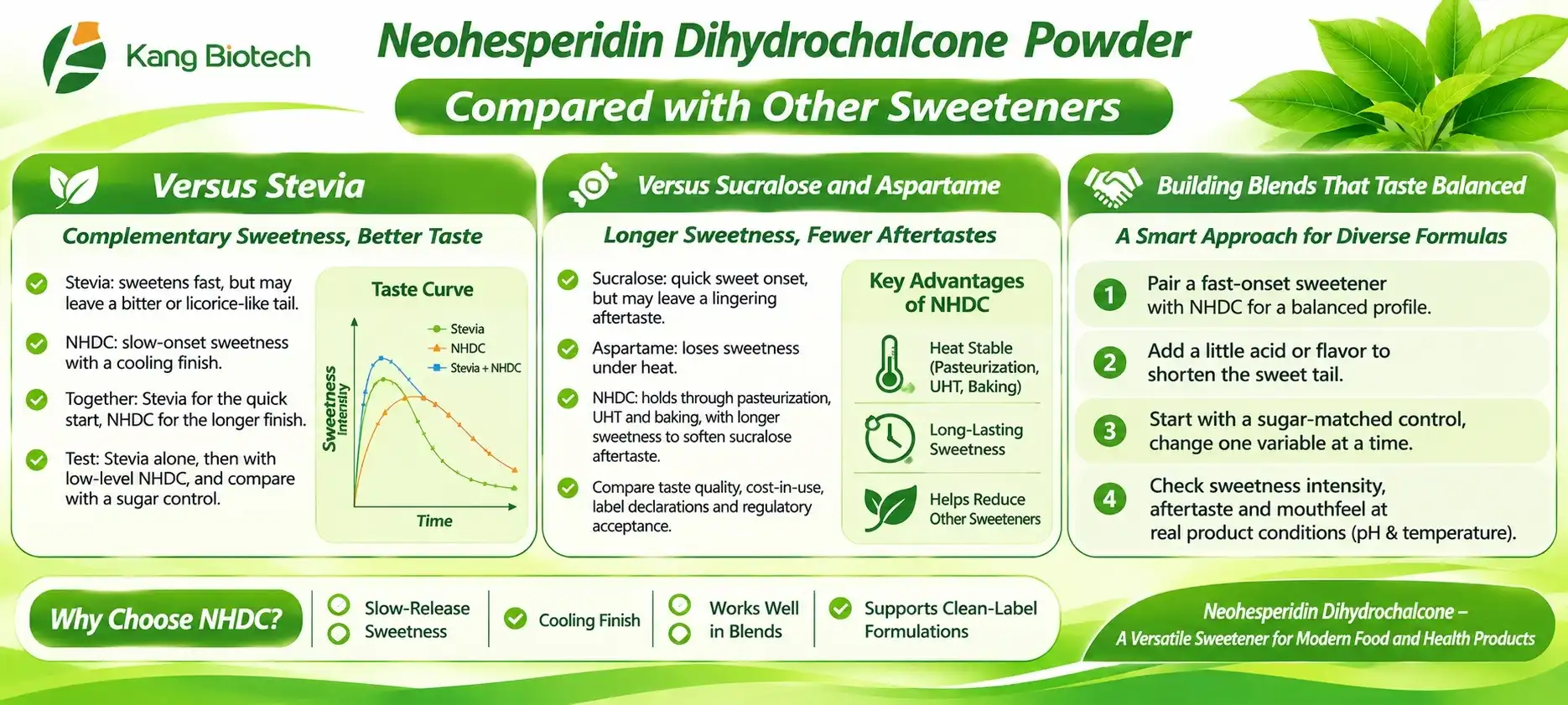
Stevia extracts sweeten strongly but can leave a bitter or licorice-like tail. Neohesperidin dihydrochalcone powder offers slow-onset sweetness with a cooling finish, and formulators often add a small amount to a stevia blend to mask those off-notes. Stevia reaches its peak faster and NHDC lasts longer, so together they cover both ends of the taste curve. Neither replaces the other in every formula. A simple bench plan tests stevia alone, then stevia with low-level NHDC, and compares both with a sugar control in the same base.
Versus Sucralose and Aspartame
Sucralose delivers a quick sweet onset but may leave a lingering aftertaste in some bases, and aspartame loses sweetness under heat. According to supplier data, neohesperidin dihydrochalcone powder holds through pasteurization, UHT, and baking, and its longer sweetness may soften the sucralose aftertaste. In a blend, it can lower the amount of the second sweetener. Compare taste quality, cost-in-use, label declarations, and regulatory acceptance together, because a lower price per kilogram does not always mean a lower cost per serving.
Building Blends That Taste Balanced
No single sweetener suits every product. A common approach pairs a fast-onset sweetener for the opening with neohesperidin dihydrochalcone powder for the long finish, plus a little acid or flavor to shorten the tail. Professional flavorists blend NHDC with other sweeteners or acids to truncate the lingering sweetness and move the profile closer to sucrose. Start with a sugar-matched control, change one variable at a time, and note sweetness intensity, aftertaste, and mouthfeel. Test at the pH and temperature your product will meet on shelf, because a simple model solution may not predict results in commercial batches.
Safety, Side Effects, and Regulatory Status of Neohesperidin Dihydrochalcone Powder
Regulatory Status in the U.S. and EU
In the European Union, NHDC is an approved food additive, E959, listed under Commission Regulation (EU) No 1129/2011. In the United States, FEMA lists it as number 3811, and FDA's GRAS Notice Inventory includes a notice for NHDC, GRN 902, which drew a no-questions response in November 2020 for several food categories. Use conditions are specific, so confirm that your food category and level fall inside the notice, and ask any supplier, including us, for the supporting documents. China lists NHDC under GB 2760, and the European Pharmacopoeia includes a monograph for it.
Safety Questions and Side Effects
Buyers sometimes ask whether NHDC belongs in the same safety debates as saccharin or cyclamate. Data answers that better than comparison does. A 13-week rat feeding study in Food and Chemical Toxicology (1990) is among the early toxicity assessments, and regulators in the EU and the U.S. have reviewed NHDC for approved uses. The reference text Sweeteners and Sugar Alternatives in Food Technology (2012) also covers how technologists blend high-intensity sweeteners to improve taste. Food use stays at ppm levels, but sensitive individuals can react to any ingredient, so review the SDS, allergen statement, and contaminant limits before launch.
Labeling and Natural Claims
Neohesperidin dihydrochalcone powder starts with a citrus flavonoid but reaches the powder stage through hydrogenation. Whether a brand may call it natural, naturally derived, or clean-label depends on the manufacturing details and on local rules, and the FDA has not set a formal regulatory definition of "natural" for food. Work with your regulatory team to settle claims, maximum use levels, import requirements, and any pre-market obligations before launch. Rules differ among the U.S., EU, U.K., Canada, Australia, and Asian markets, so check each one separately.
How to Evaluate a Neohesperidin Dihydrochalcone Powder Supplier
Documents and Tests to Request
A purity number alone does not qualify a neohesperidin dihydrochalcone powder supplier. Ask for the specification sheet, a certificate of analysis for the lot you receive, the SDS, and regulatory statements for your market. Review the assay method, moisture, heavy metals, microbiological limits, and residual solvents. We quantify our NHDC by HPLC-UV at 282 nm. Our testing covers lead below 3 mg/kg, arsenic below 2 mg/kg, and total plate count below 1,000 cfu/g, and the product complies with EP and FCC guidelines. Many buyers also order a report from an accredited third-party laboratory on first lots, and we welcome that check.
Manufacturing and Quality Systems at Kang Biotech
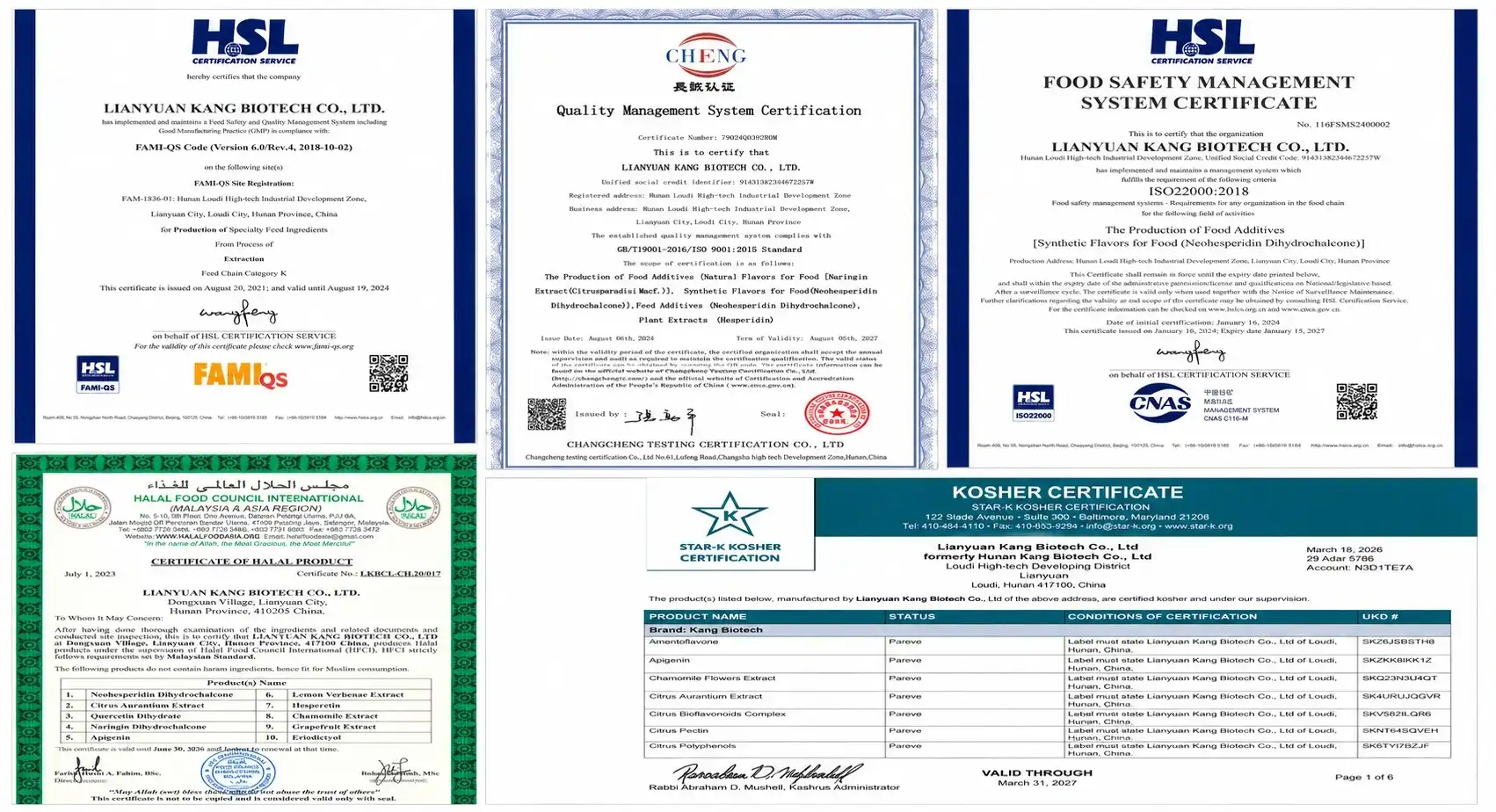
Founded in 2011, Kang Biotech manufactures directly, and our technical team has more than 20 years of experience in citrus extraction. Nine production lines run in our plant. Our systems hold ISO 9001, ISO 22000, HACCP, Halal, Kosher, FAMI-QS, and SC (China Food Production License) certifications. We also run a joint research center with the Hunan Institute of Agricultural Product Processing and Quality Safety, which works on extraction methods and quality improvement. Customers in more than 40 countries buy from us. Buyers who run supplier audits can ask our sales team about audit arrangements.
Samples, MOQ, Packaging, and Shipping
We keep our neohesperidin dihydrochalcone powder in stock. The minimum order is 1 kg, and samples are available for lab evaluation. Standard packaging is a 25 kg drum, and sealed storage in a cool, dry place keeps the powder for 24 to 36 months. Small orders ship by express courier, and bulk orders travel by air or sea freight, depending on your schedule. When you compare quotes, ask for price tiers by quantity and by Incoterm, and calculate landed cost and cost-in-use instead of price per kilogram alone. We also offer OEM and ODM services, including specification adjustments, packaging, and labeling.
A Practical Qualification Path
Most formulation teams follow a similar sequence. Define the product category, target market, claims, annual volume, and required certificates. Request samples and documents from two or three suppliers. Run bench and sensory trials for dispersion, sweetness, aftertaste, and pH and heat stability. Review quality documents and any third-party reports, then place a pilot order before you sign a long-term contract. Confirm specifications, pricing, payment terms, Incoterms, and change-notification procedures in writing. Our technical team can help with documentation and application questions at each step.
Conclusion
Neohesperidin dihydrochalcone powder is a citrus-derived, high-intensity sweetener, about 1,500 to 1,800 times sweeter than sucrose, that works best in blends. Its slow, lasting sweetness and bitterness-masking ability support sugar reduction in beverages, dairy, confectionery, bakery goods, supplements, and oral care, provided formulators match dosage, pH, and dissolution method to the actual product. It dissolves poorly in cold water, so premixes and trial records matter. Compared with stevia, sucralose, and aspartame, it fills different gaps in taste and heat stability, and bench trials in the real matrix decide the best blend. Regulatory status in the U.S. and EU, label wording for natural claims, and safety documentation need market-specific checks. A supplier earns trust through complete specifications, certificates of analysis, quality systems, and clear shipping terms.
FAQ
1. Is neohesperidin dihydrochalcone powder a natural sweetener?
It starts from neohesperidin in citrus, and manufacturers make it by hydrogenation. Whether you may label it natural depends on local rules, so confirm with your regulatory team.
2. How much do I need per batch?
Supplier guidance is about 10–50 ppm for sweetening and 1–5 ppm for bitterness masking. Set the final level through sensory trials and local use limits.
3. What are the MOQ and shelf life?
Our minimum order is 1 kg, samples are available, and standard packing is a 25 kg drum. Stored sealed in a cool, dry place, it keeps for 24 to 36 months.
4. Does it hold up in acid and heat?
Supplier data shows stability from pH 2 to 7 and through pasteurization, UHT, and baking. Confirm this in your own formula.
5. How do I dissolve it?
Use hot water or an ethanol-water mix, since cold water dissolves only about 0.4 to 0.5 g/L. Many plants prepare a concentrated premix first.
Request Neohesperidin Dihydrochalcone Powder Samples from Kang Biotech
Looking for a neohesperidin dihydrochalcone powder manufacturer that keeps stock and answers technical questions? Kang Biotech offers 98% HPLC food-grade powder, 1 kg minimum orders, samples, and 25 kg drums, backed by ISO 9001, ISO 22000, Halal, Kosher, and FAMI-QS systems. Send your application, target market, and volume to sales02@kangbiotech.com, or visit cnkangbiotech.com for details. Our team will reply with specifications, a certificate of analysis, and sample options.
References
1. Alternative Sweeteners, 3rd ed., 2001. Borrego, F., and Montijano, H. "Neohesperidine Dihydrochalcone."
2. Food and Chemical Toxicology, 1990. Lina, B.A.R., et al. "Subchronic (13-week) oral toxicity of neohesperidin dihydrochalcone in rats."
3. BMC Structural Biology, 2007. Winnig, M., et al. "The binding site for neohesperidin dihydrochalcone at the human sweet taste receptor."
4. Sweeteners and Sugar Alternatives in Food Technology, 2012. O'Donnell, K., and Kearsley, M.W. (eds.).
5. Official Journal of the European Union, 2011. Commission Regulation (EU) No 1129/2011 on food additives, Annex II to Regulation (EC) No 1333/2008.
6. FDA GRAS Notice Inventory, 2020. GRAS Notice No. GRN 902, neohesperidin dihydrochalcone.

Send Inquiry
Related Industry Knowledge
- Neohesperidin Dihydrochalcone Powder as a Natural Sweetener
- Retaliating Properties of Naringin: A Mini-Review
- The Natural Enhancer: Unpacking Horny Goat Weed
- How Neohesperidin Powder Supports Antioxidant Formulations
- Nobiletin: The Flavonoid You Probably Never Knew Your Bones Needed
- 5 Potential Health Benefits of Apigenin
- NDHC: an updated review on a naturally derived sweetener and flavor potentiator
- Neohesperidin Dihydrochalcone Powder vs Stevia: Which Natural Sweetener Wins?
- What Is Apigenin Powder and Why Is It Gaining Popularity in Supplements?
- Hesperidin: A Citrus Treasure with a Rich History