
NDHC: an updated review on a naturally derived sweetener and flavor potentiator
October 29, 2026
Neohesperidin dihydrochalcone powder (NHDC) has drawn steady attention from food scientists and procurement teams alike over the past decade. Derived from neohesperidin, a naturally occurring flavonoid glycoside found in bitter orange (Citrus aurantium), this white crystalline ingredient carries CAS No. 20702-77-6 and a molecular formula of C₂₈H₃₆O₁₅. At roughly 1,500–1,800 times the sweetness of sucrose with near-zero caloric contribution, neohesperidin dihydrochalcone powder functions as both a high-intensity sweetener and a flavor modifier — making it particularly relevant for brands building zero-sugar, clean-label product lines across beverages, dairy, confectionery, and nutraceuticals.
What Is Neohesperidin Dihydrochalcone (NHDC)?
Chemical Identity and Natural Origin
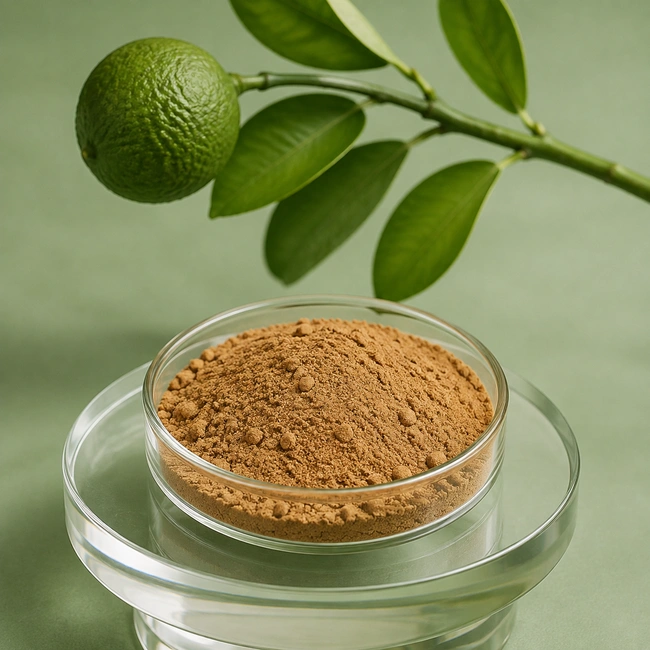
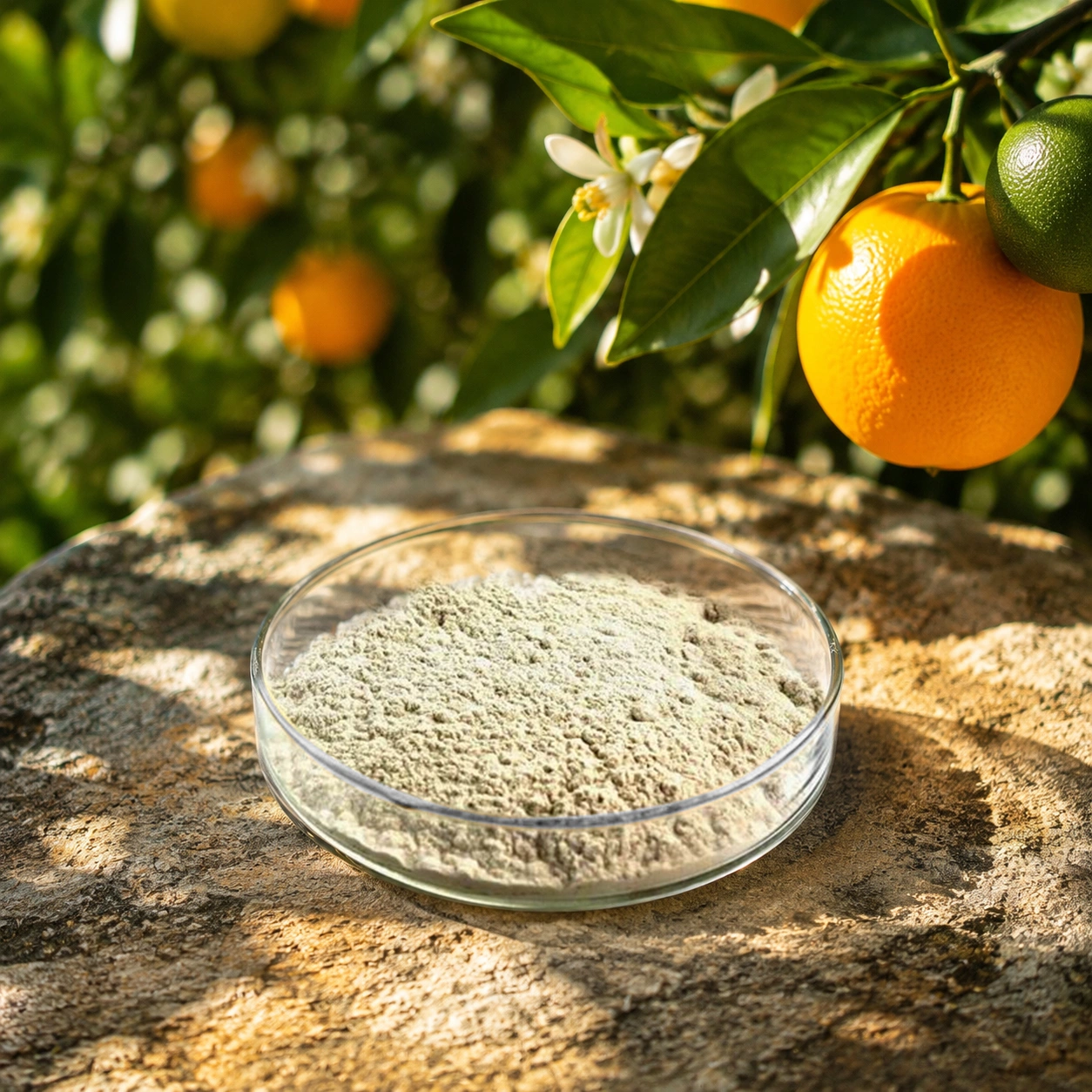
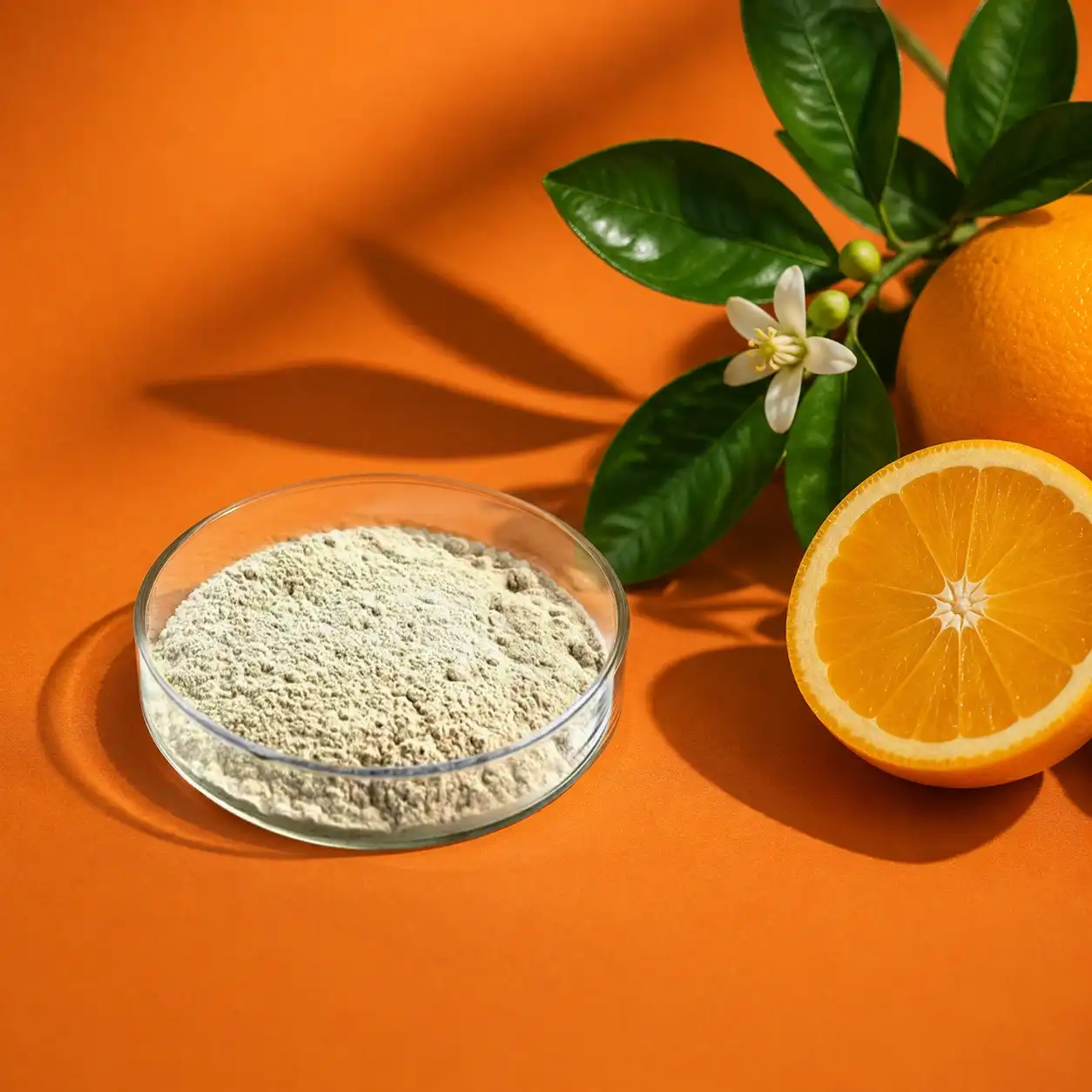
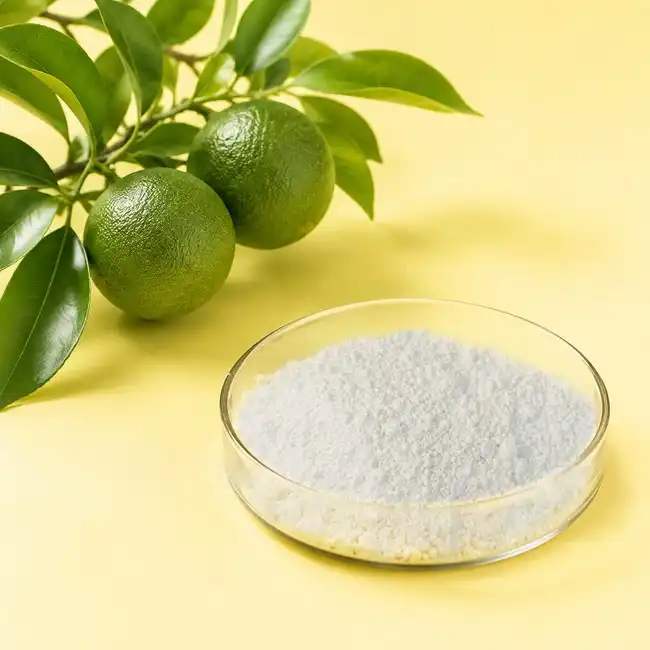
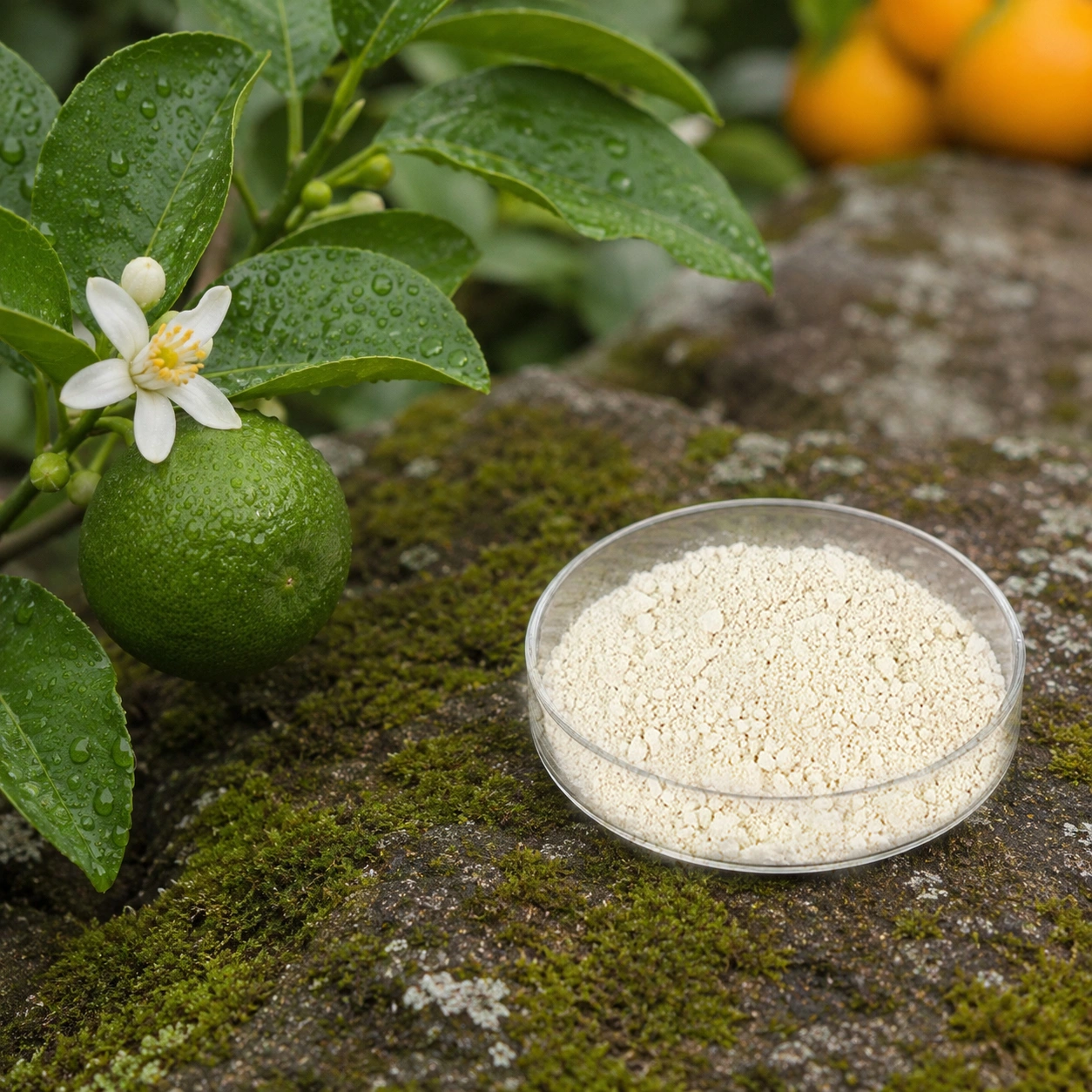
It is important to be careful when hydrogenating neohesperidin, which is found in bitter orange peel. Bitter orange plantations covering more than 20,000,000 m² are where Kang Biotech gets its raw materials. This makes sure that the plant's source can be found. Neohesperidin dihydrochalcone powder is a crystal-shaped substance that ranges in color from white to off-white. The melting point is between 156°C and 158°C, and an HPLC test shows that it is at least 98% pure.

Dual Function: Sweetener and Flavor Potentiator
NHDC can change the way people taste things in very small amounts instead of just one thing. It hides the bitter taste of plant-based foods, broken down proteins, and stevia rebaudioside A at 1 to 5 parts per million. It can be used to measure sweetness between 10 and 50 parts per million. It takes a long time to start and goes on slowly. One ingredient can be used to fix off-notes and make things taste better because it works in two different ways.
Sweetness Profile Compared to Sucrose
Neohesperidin dihydrochalcone powder gets sweeter more slowly than sugar. It lasts a lot longer when it's at its best. This sweetness lasts longer, which makes it less "sharp and fleeting" than when you use acesulfame-K or saccharin. This changes the way things feel when you eat them. It doesn't add many calories to food because the amount used is in parts per million. This label claim is very important if you want to follow the rules for sugar taxes in the EU, the UK, and Mexico.
Benefits and Safety of NHDC in Food and Beverage Applications
Stability Across Processing Conditions
Neohesperidin dihydrochalcone powder stays chemically stable at temperatures as high as 160°C. It stays sweet even after being warmed, treated with UHT, or baked at room temperature. The pH range for soft drinks, fruit juices, and most other fizzy drinks is between 2 and 7. This means that it can be used across these processing conditions. It doesn't work well with heat or acid, just like aspartame, but this one does. This helps you work with it better.
International Regulatory Approvals
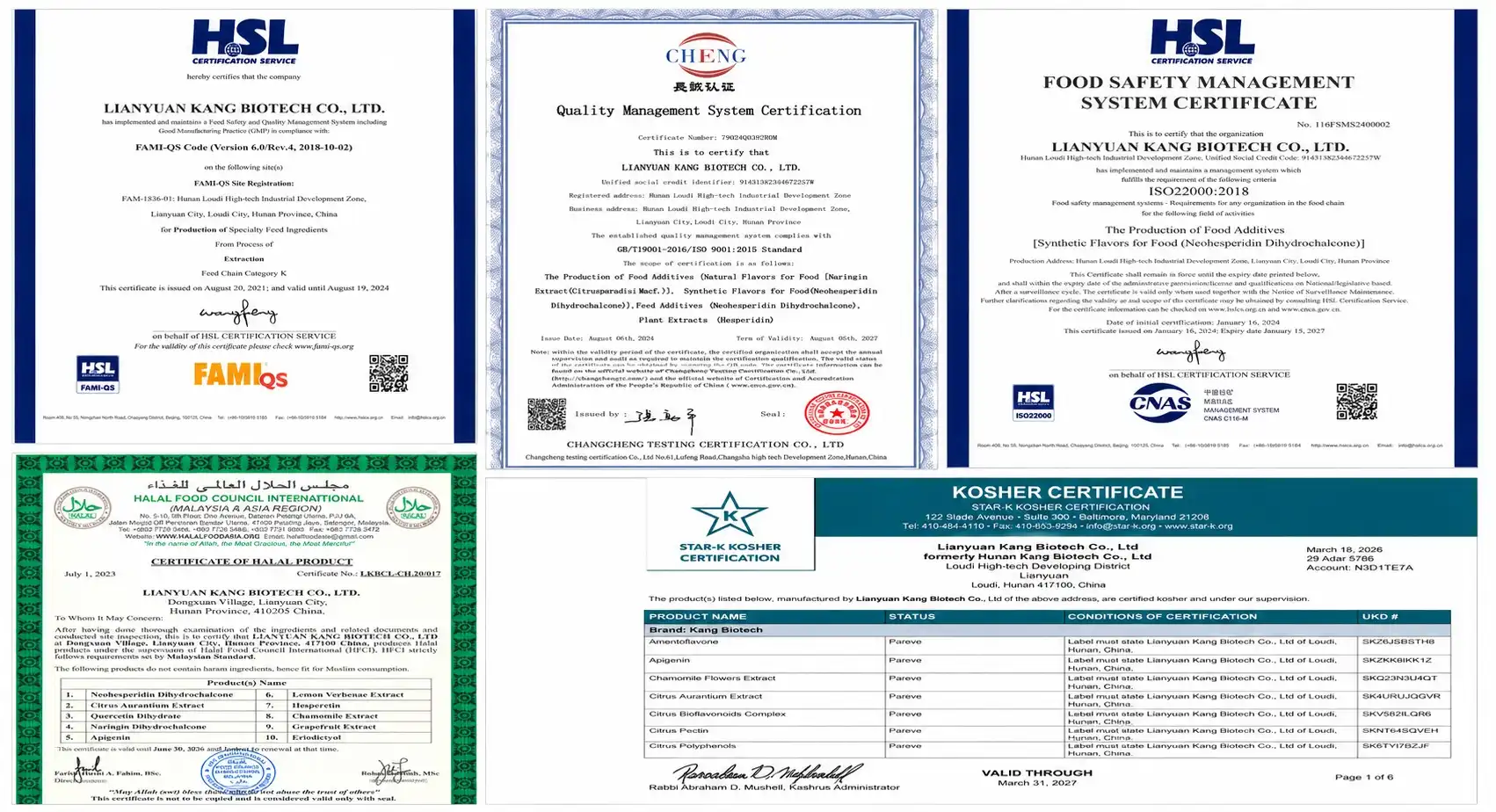
To add to food in the EU, it is called E959. You can find it in China under the number S0269 and in the US under the name FEMA 3811. A letter from the FDA says it's okay to use at 10 to 1,000 parts per million in some types of food (GRN 902, November 2020). It's also in EP 9.0, the European Pharmacopeia. Kang Biotech's neohesperidin dihydrochalcone powder is also recognized as Halal, Kosher, and FAMI-QS. All of these are important licenses for buying teams that work with shops around the world.
Safety Data and Recommended Usage Levels
Both the FDA and the EFSA have checked to make sure that NHDC is safe. Lead and arsenic levels can't be higher than 3 mg/kg and 2 mg/kg, respectively, at Kang Biotech. Also, the total plate count can't be more than 1,000 cfu/g. Around 10 to 50 ppm is usually the range for amounts that make things sweet. It only takes 1 ppm to change the taste. Cost changes at the batch level are very small because of these small dose requirements, even for very high-end ways of making the medicine.
Comparative Analysis: NHDC vs. Other Sweeteners
NHDC vs. Stevia and Monk Fruit
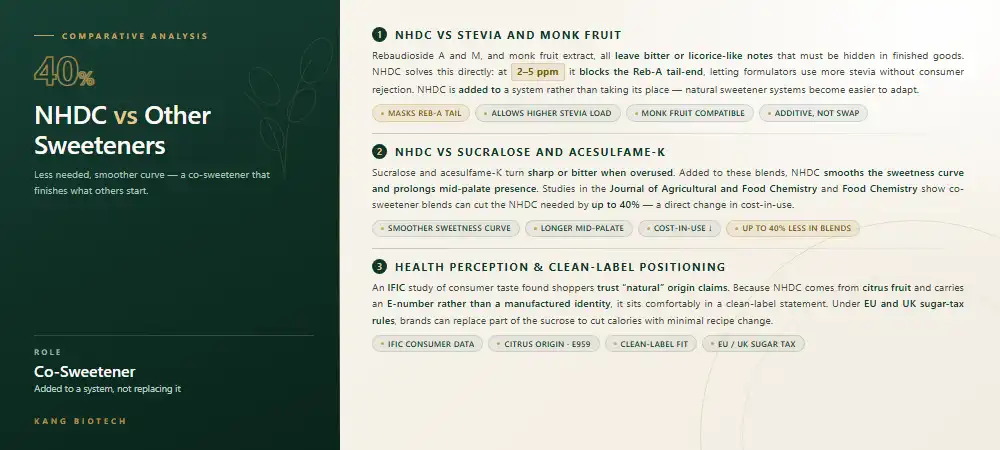
Each of these sweeteners—rebaudioside A and M—as well as monk fruit extract—leaves behind bitter or licorice-like tastes that need to be hidden in finished goods. Neohesperidin dihydrochalcone powder directly solves this issue. At 2–5 ppm, it blocks the taste of the rebaudioside tail-end, which lets formulators add more stevia without users rejecting the product. This means that NHDC can be added to something instead of taking its place. We can now use natural sweetener systems that are more easily changed to fit our needs.
NHDC vs. Sucralose and Acesulfame-K
Sugar or acesulfame-K both leave a sharp or bitter taste behind if you use too much of them. When added to these mixtures, neohesperidin dihydrochalcone powder smooths out the sweetness curve and prolongs the mid-palate presence. Journal of Agricultural and Food Chemistry and Food Chemistry both have studies that show NHDC can be mixed with other co-sweeteners to make up to 40% less of it needed. This changes how much it costs to get ready in a direct way.
Health Perception and Clean-Label Positioning
A study by the International Food Information Council (IFIC) on consumer tastes found that shoppers believe claims of "natural" origin. It fits better in a clean-label statement because NHDC comes from citrus fruits and has an E-number instead of a made identity. Some businesses in the EU and UK have to follow the rules for the sugar tax. They can replace some sucrose with neohesperidin dihydrochalcone powder to cut calories without having to make many changes to their recipes.
Procurement Guide for NHDC Powder: Sourcing and Buying Considerations
What to Look for in a Supplier
Buyers should make sure that the following are true about a supplier before they approve them:
- Purity verification: Minimum 98% HPLC assay with lot-to-lot COA traceable to production batch numbers.
- Certifications on file: E959 (EU), GRN 902 / FEMA 3811 (USA), GB 2760 (China), Halal, Kosher, FAMI-QS — all current and available upon request.
- MOQ and sampling policy: 1 kg minimum order with samples available; 25 kg/drum standard packaging for bulk supply.
- Logistics options: FedEx for small trial orders; air or sea freight (FOB/DDP) for commercial volumes, with ready stock available for fast dispatch.
For a stable output plan and less risk during onboarding, make sure you meet these needs. The expert team at Kang Biotech needs 24 to 48 hours to respond to questions about recipe and requests for paperwork. This takes about the same amount of time as R&D-led buying processes.
Quality Testing and Traceability
An HPLC-UV detection at 282 nm is used by Kang Biotech to look over the test data. More than that, microbiological tests, heavy metal screening, and checks for loss on drying (goal <12%) are carried out. The production chain is set up in a way that lets both customers and authorities look at it. Each production batch can be traced back to a farm in Lianyuan, Hunan, by its lot number. The goods in this case meet the requirements of EP, FCC, and USP.
Pricing Structure and Order Flexibility
Neohesperidin dihydrochalcone powder comes in a lot of different sizes, from 1 kg for single tests and samples to several tons per year. Kang Biotech has different levels of stock prices for both FOB and DDP. This helps buyers understand how much things cost for various order sizes. For OEM and ODM, you can change the specs, get private labels, and get help with the recipe, among other things.
Future Trends and Strategic Insights in NHDC Usage
Clean-Label Regulatory Pressure Is Accelerating Demand
The world market for high-intensity sweeteners will grow at a rate of 5.8% per year until 2030. This is because more countries in Europe, Latin America, and Southeast Asia are taxing sugar. For brands that want to add less sugar to their recipes, natural, high-potency options are becoming more and more important. Neohesperidin dihydrochalcone powder is a good choice for this change since it comes from citrus fruits and has already been approved by the government. It doesn't need to be cleared as a new food in most of the places it's meant to go.
Innovation Opportunities in Functional Beverages and Supplements
NHDC is being used more and more in drinks with added protein and plant vitamins because it can cover up bitter tastes. You're more likely to make a mistake if you add more helpful things, like extra B vitamins, adaptogens, or plant protein. When present in amounts less than 5 ppm, neohesperidin dihydrochalcone powder eliminates these notes. It doesn't change the taste of the final product, so it has a clean taste.
Building a Resilient Sweetener Supply Chain
Teams that buy things work best with producers who can help them with all three steps at the same time. This is called the Idea–Development–Industrial (I+D+I) framework. To make sure that each batch is the same, it's better to have direct relationships with manufacturers than long-term contracts. More so for companies that can choose where their raw materials come from and how long they have to wait for them. To get a brand from the lab test to the market in 60 to 90 days, the supply chain needs to be very well set up. The things that go into it must also work well.
Conclusion
NHDC has earned its place in the formulator's toolkit through a combination of measurable functional properties and solid regulatory standing. Its ability to deliver intense sweetness at ppm-level doses, suppress off-notes from co-sweeteners, and survive demanding processing conditions makes it applicable across a wide range of product categories. For procurement professionals evaluating natural sweetener options, neohesperidin dihydrochalcone powder offers a documented, multi-market approved ingredient with transparent sourcing and scalable supply. The science behind it is established, the regulatory path is clear, and the practical formulation advantages are reproducible — three qualities that translate directly into lower reformulation risk.
FAQ
1. Is NHDC safe for use in mainstream food and beverage products?
Yes. NHDC carries EU E959 approval, FEMA 3811 GRAS status in the US, FDA no-objection status under GRN 902 (November 2020), and GB 2760 listing in China. EFSA completed a full safety evaluation supporting its use across multiple food and beverage categories at doses up to 1,000 ppm.
2. How sweet is neohesperidin dihydrochalcone powder relative to table sugar?
NHDC is approximately 1,500–1,800 times sweeter than sucrose on a weight basis. Because effective use levels fall between 10 and 50 ppm for sweetening applications, its contribution to caloric content per serving is effectively zero.
3. Can NHDC be blended with other high-intensity sweeteners?
Yes, and this is one of its most practical attributes. Neohesperidin dihydrochalcone powder works well in combination with stevia, sucralose, acesulfame-K, and aspartame. Blending at low concentrations (1–5 ppm) suppresses bitter or metallic off-notes, while higher concentrations (10–50 ppm) contribute measurable sweetness.
4. What is the standard shelf life of NHDC powder?
When stored sealed in original 25 kg fiber drums under cool, dry conditions, neohesperidin dihydrochalcone powder maintains its sweetness integrity for 24–36 months without significant purity loss.
5. Does neohesperidin dihydrochalcone powder dissolve easily in water?
Solubility in cold water is low (approximately 0.4–0.5 g/L). For industrial liquid applications, it is commonly prepared as a concentrated master batch using hot water or an ethanol-water matrix, then diluted into the final formula.
Source Your NHDC Supply Through Kang Biotech — A Trusted Neohesperidin Dihydrochalcone Powder Manufacturer
They also have all the paperwork the government needs, such as certified copies of E959, FEMA 3811, GRN 902, Halal, Kosher, and FAMI-QS foods for neohesperidin dihydrochalcone powder. We can help you get ready for the first sample or the mass production. We have 1 kg in stock right now, and it takes 24 to 48 hours for a technician to respond. You can get a COA, a sample, or price quotes for a big order by emailing sales02@kangbiotech.com or going to cnkangbiotech.com.
References
-
Borrego, F., & Montijano, H. (2001). Neohesperidin dihydrochalcone in food applications. International Sugar Journal, 103(1231), 396–401.
-
European Food Safety Authority (EFSA). (2011). Scientific opinion on the re-evaluation of neohesperidin dihydrochalcone (E 959) as a food additive. EFSA Journal, 9(3), 2030.
-
Kroyer, G. (2010). Stevioside and neohesperidin dihydrochalcone as sweetening agents. Innovative Food Science & Emerging Technologies, 11(2), 210–214.
-
Nabors, L. O. (Ed.). (2012). Alternative Sweeteners (4th ed.). CRC Press.
-
Carocho, M., Morales, P., & Ferreira, I. C. F. R. (2017). Sweeteners as food additives in the XXI century: A review of what is known and what is to come. Food and Chemical Toxicology, 107, 302–317.
-
DuBois, G. E., & Prakash, I. (2012). Non-caloric sweeteners, sweetness modulators, and sweetener enhancers. Annual Review of Food Science and Technology, 3, 353–380.

Send Inquiry
Related Industry Knowledge
- How to Select a Bulk Naringenin Powder Supplier
- Apigenin for Sleep: What This Chamomile Compound Does
- 4 Benefits of Naringin For Your Health
- Glucosyl Hesperidin Bulk Supplier: What Buyers Should Check
- 3 Health Benefits of Horny Goat Weed
- Apigenin: Health Benefits, Sources, and Safety
- How to Use Neohesperidin Dihydrochalcone Powder in Beverages for a Low-Calorie Boost?
- Exploring Hesperetin Powder for Modern Cosmetic Formulation
- Evidence for the Health Effects of Hesperidin
- What Is Apigenin Powder and Why Is It Gaining Popularity in Supplements?