
Exploring Antioxidant Applications of Polymethoxy Flavonoids Powder
November 3, 2026
Polymethoxy flavonoids powder has become one of the more discussed citrus-derived ingredients in the nutraceutical and functional food space over the past decade. Standardized extracts containing Nobiletin and Tangeretin — the two primary active markers — show measurable free radical scavenging activity at the cellular level, making polymethoxy flavonoids powder a practical choice for brands building antioxidant, anti-inflammatory, or metabolic health formulas. This guide walks through the science, sourcing realities, and procurement considerations that matter most to B2B buyers evaluating this ingredient for the first time or at scale.
Understanding Polymethoxy Flavonoids Powder and Its Antioxidant Properties
What Makes PMFs Chemically Distinct
This powder is made from the peel of Citrus sinensis and other species that are related. The flavone backbone has more than one methoxyl group on it, which makes it different from other orange flavonoids. With these methoxyl groups, it's easier for things to move through cell walls without moving them directly. That is, they are taken in more quickly and reach more tissues than flavonoids that have been glycosylated, such as hesperidin.
Free Radical Neutralization Mechanisms
The main molecules in high-grade polymethoxy flavonoids powder are Nobiletin and Tangeretin. They stop NF-κB signaling pathways and lower the production of cytokines that cause inflammation. Peer-reviewed journals have shown that DPPH can remove radicals. But because PMFs like fat, transport methods that use oil usually work better in living things than those that use water.
Thermal and pH Stability
At temperatures up to 120°C and in a pH range of 3.0 to 8.0, Kang Biotech's PMF extract still works. If your business makes hot-fill drinking lines or spray-drying systems, this is very important. The moisture level is kept below 5%, so the powder stays safe while it's being stored and shipped. In a normal warehouse, the powder would need to be refrigerated, but this doesn't happen.
Comparing Polymethoxy Flavonoids Powder with Other Flavonoids and Antioxidants
PMFs vs. Hesperidin and Naringin
Normal orange flavonoids, like Naringin and Hesperidin, have sugar groups that block membranes from letting things pass. Because of its lipophilic structure, polymethoxy flavonoids powder avoids this issue and is therefore more accessible at the same amounts. This difference in how well something works affects the dose and cost-per-effective-unit for formulators who are trying to improve the health of people with metabolic syndrome or heart disease.
Broad-Spectrum Profile vs. Single-Molecule Ingredients
When you buy a full PMF complex, you get Nobiletin, Tangeretin, and trace Sinensetin all at once. You can also buy single molecules of Nobiletin. This profile of many compounds can't be made by just a few molecules acting on their own. Some lines of life or anti-aging supplements say that a product is a broad-spectrum citrus PMF, but the HPLC fingerprint of the raw material needs to support that claim. Kang Biotech's 80% HPLC-standardized polymethoxy flavonoids powder makes sure that every batch has the same amount of active markers.
Organic vs. Conventional Sourcing Considerations
When people buy things, they may ask about PMF material that has been approved as organic. But when you need a lot of them, approved organic batches cost more and take longer to get. Kang Biotech has checked over 400 orchards for pesticide residues that are safe to use. These ingredients meet the functional and regulatory needs of most North American supplement brands without making the price go up.
Procurement Insights: Sourcing and Buying Polymethoxy Flavonoids Powder
Evaluating Supplier Credentials
Getting proof is the first thing you should do when looking for a source for polymethoxy flavonoids powder. There must be a full Certificate of Analysis that explains the test method (HPLC), the amounts of heavy metals found (Pb, As, Cd, and Hg according to USP ¤233>), the amount of solvent left over (GC-MS, below ICH 5000 ppm for ethanol), and the number of bugs that were discovered. It's tough to check on suppliers who can't show HPLC-DAD fingerprint data that displays the Nobiletin-to-Tangeretin ratio, and it's also tougher to explain them to regulatory experts or research teams.
Here are the most important pieces of paperwork you should look over before you place a large order:
- Assay method and result: 80% minimum total PMFs by HPLC, with Nobiletin and Tangeretin individually identified
- Heavy metals panel: USP <233> compliance; results for all four regulated metals
- Residual solvents: GC-MS confirmation that ethanol extraction residuals fall below ICH thresholds
- Botanical authenticity: Carbon-14 dating or flavonoid ratio data to confirm 100% citrus origin and rule out synthetic spiking
- Third-party testing: Batch-level COA supported by an accredited external lab
We used HPLC to find at least 80% of the total PMFs, and Nobiletin and Tangeretin were found separately. The heavy metals panel followed USP <233> and got results for all four controlled metals.
Packaging, MOQ, and Logistics
Kang Biotech sends polymethoxy flavonoids powder in fiber drums with two food-grade polyethylene liners. One kg is the least you can buy, and you can get samples to try out different mixes. Large amounts of goods are moved by air or sea freight for businesses. FedEx only ships small items. All of the packages come with all the customs paperwork that is needed.
Certifications That Matter for North American Buyers
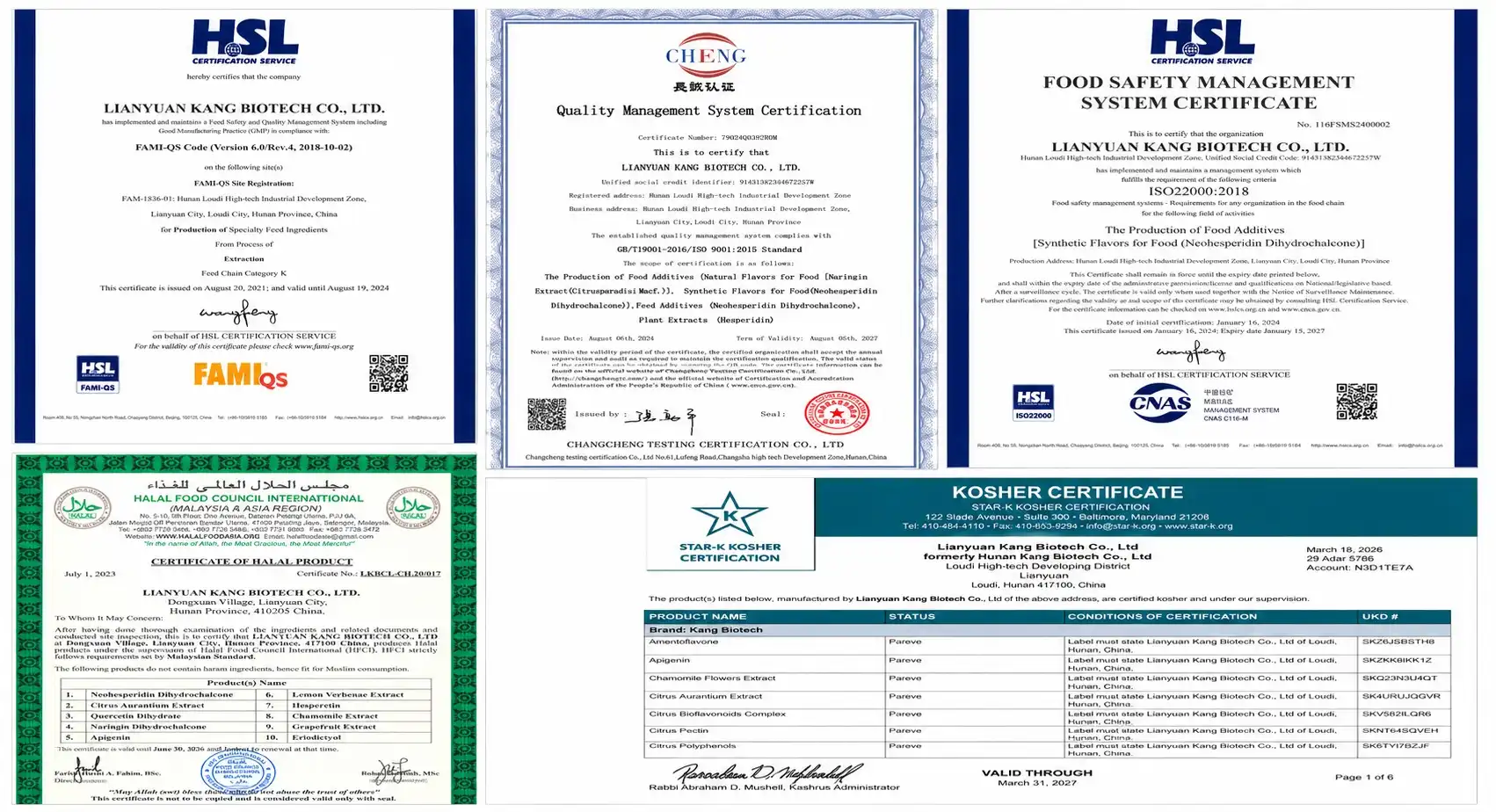
Kang Biotech is FAMI-QS, ISO 9001, ISO 22000, HACCP, and Halal or Kosher certified. When they make things, all nine production lines have to follow GMP rules. These skills are important for procurement teams whose goods are checked by qualified dietitian consultants or for stores whose goods are checked for quality by a third party.
Practical Applications and Usage Guidelines for Polymethoxy Flavonoids Powder
Dietary Supplements and Capsule Formats
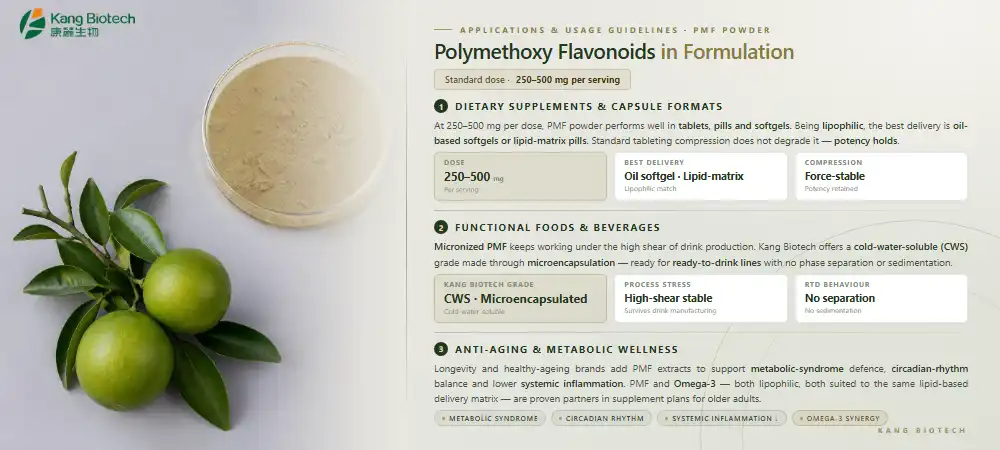
When added in normal amounts of 250 to 500 mg per dose, polymethoxy flavonoids powder works well in pills, tablets, and softgels. Since it is lipophilic, the best way to give it is in the form of oil-based softgels or lipid-matrix pills. Standard forces that squeeze the powder don't break it, and it stays strong.
Functional Foods and Beverages
The micronized PMF powder keeps working even when it is mixed with a lot of force while drinks are being made. Kang Biotech makes one that can be used in water and is called cold-water-soluble (CWS). This one is made through microencapsulation. Because of its shape, the ingredient can be used in ready-to-drink lines without having to worry about phase separation or sedimentation.
Anti-Aging and Metabolic Wellness Formulations
To help fight metabolic syndrome, support the circadian rhythm, and lower inflammation all over the body, longevity and healthy-aging brands have added PMF extracts to their formulas. Because they are both lipophilic chemicals and benefit from the same lipid-based delivery matrix, polymethoxy flavonoids powder and Omega-3 fatty acids have been shown to work well together in supplement plans for older people.
Future Trends and Innovations in Polymethoxy Flavonoids Powder Applications
Clean-Label and Natural Antioxidant Demand
In North America, more care is being taken than ever before to read chemical labels. Because people want clean label goods that come from clear natural sources, citrus PMF extracts can be used instead of man-made vitamins. This site is a good fit for polymethoxy flavonoids powder, which comes from accepted trees and is checked using open and honest testing methods.
Advances in Bioavailability Technology
In order to make PMF products that are lipophilic and solutions that are based on water more bioavailable, nano-emulsification and encapsulation technologies are being used. That's right, these changes mean that polymethoxy flavonoids powder can now be used in more things, like candies and functional drinks, where powder stability used to be an issue.
Regulatory and Sustainability Considerations
People in the U.S. think of PMF ingredients made from orange peel as food parts, not as GRAS ingredients on their own. In the EU, they are called Novel Foods when used in certain ways. Buyers for North American brands should carefully keep track of data on where they get their goods, how they're processed, and what they find. In Lianyuan, Hunan Province, Kang Biotech has a 33,000 m² GMP center and 20,000,000 m² of controlled bitter orange farms that are part of its supply chain. This helps with the paperwork that regulatory papers need to be able to be tracked.

Conclusion
The polymethoxy flavonoids powder stands out in the market for antioxidant ingredients. Many supplement brands, functional food makers, and distributors need a standard, traceable citrus extract. This one is a good choice because it is lipophilic, has a broad-spectrum PMF profile, and stays stable at high temperatures. When you buy something directly from the maker, you can be more certain of the important things, like fingerprint paperwork, assay accuracy, third-party proof, and the supply being reliable. Orange oils have been made by Kang Biotech since 2011. From the farm to the finished powder, they are in charge of the whole process. This makes it less likely that changes will happen between runs.
FAQ
1.What does "80% HPLC" mean on a PMF Certificate of Analysis?
High-performance liquid chromatography showed that 80% of the powder's weight is made up of total polymethoxylated flavones. The two main markers that have been found are nobiletin and tangeretin. There should be a DAD fingerprint that backs up this number and shows the exact proportion of each marker, not just the sum of them all.
2.How stable is polymethoxy flavonoids powder during manufacturing?
From pH 3.0 to 8.0, the powder can handle it, and it's safe up to 120°C. As long as the moisture level stays below 5%, this level of stability stays the same while it is being stored and moved. Monthly stability data shows that it will last for 24 months if it is sealed, kept cool, and kept dark.
3.Is polymethoxy flavonoids powder water-soluble?
The normal PMF powder is lipophilic, which means it doesn't mix well with water. For water-based goods, there is a type that breaks down in cold water. This type is created by emulsification or microencapsulation.
4.What documentation should I request before a bulk order?
Make sure you get the full COA. It should have an HPLC test, the amounts of Nobiletin and Tangeretin, a heavy metals panel, the results of the residual solvent test, microbiological counts, and details about the plants the product came from.
5.What is the minimum order quantity?
Only 1 kg is the least you can order. Samples can be used to help come up with a new recipe before a business order is placed.
Partner with Kang Biotech for Your Polymethoxy Flavonoids Powder Supply
Kang Biotech has its own GMP-certified plant where it makes polymethoxy flavonoids powder. This way, the whole process can be tracked and proven, from the raw materials to the finished extract. We have our 80% HPLC-standardized PMF powder in stock and ready to ship. Small items can be sent by FedEx, and big ones can be sent by air or sea. For more than ten years, we've been getting flavonoids from citrus fruits and making straight polymethoxy flavonoids powder. Full COA paperwork, OEM/ODM customization, and quick technical help for formulation teams are all things we can do for you. You can talk about how much you need or ask for a sample by emailing sales02@kangbiotech.com or visiting cnkangbiotech.com.
References
1. Benavente-García, O., & Castillo, J. (2008). Update on uses and properties of citrus flavonoids: New findings in anticancer, cardiovascular, and anti-inflammatory activity. Journal of Agricultural and Food Chemistry, 56(15), 6185–6205.
2. Mulvihill, E. E., & Huff, M. W. (2010). Antiatherogenic properties of flavonoids: Implications for cardiovascular disease. Canadian Journal of Cardiology, 26(Suppl A), 17A–21A.
3. Yoshimizu, N., Otani, Y., Saikawa, Y., et al. (2004). Anti-tumour effects of nobiletin, a citrus flavonoid, on gastric cancer include: Antiproliferative effects, induction of apoptosis and cell cycle deregulation. Alimentary Pharmacology & Therapeutics, 20(Suppl 1), 95–101.
4. Manthey, J. A., & Grohmann, K. (2001). Phenols in citrus peel byproducts: Concentrations of hydroxycinnamates and polymethoxylated flavones in citrus peel molasses. Journal of Agricultural and Food Chemistry, 49(7), 3268–3273.
5. Kurowska, E. M., & Manthey, J. A. (2004). Hypolipidemic effects and absorption of citrus polymethoxylated flavones in hamsters with diet-induced hypercholesterolemia. Journal of Agricultural and Food Chemistry, 52(10), 2879–2886.
6. Li, S., Pan, M. H., Lo, C. Y., et al. (2009). Chemistry and health effects of polymethoxyflavones and hydroxylated polymethoxyflavones. Journal of Functional Foods, 1(1), 2–12.

Send Inquiry
Related Industry Knowledge
- Glucosyl Hesperidin: Rethinking Hesperidin in Drinks
- Apigenin Benefits: Sleep, Anxiety, Healthy Aging, and More
- 5 Potential Health Benefits of Apigenin
- 4 Benefits of Naringin For Your Health
- The Power of Naringin
- Naringenin Powder vs Naringin: Key Differences Explained
- Nobiletin Uses, Benefits & Dosage
- Naringenin Powder in Dietary Supplements: Formulation Guide
- What Is Naringenin Powder and How Is It Used?
- Evidence for the Health Effects of Hesperidin