
Glucosyl Hesperidin Bulk Supplier: What Buyers Should Check
October 26, 2026
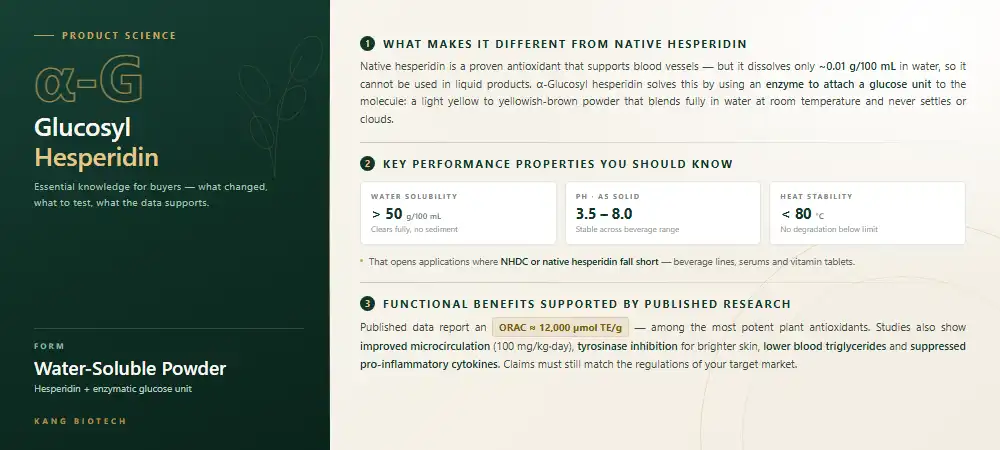
Buyers of bulk glucosyl hesperidin need more than a competitive pricing. The suitable provider will have validated purity data, reliable solubility performance, complete regulatory paperwork and quick technical support. α-Glucosyl Hesperidin (CAS No. 161713-86-6) is a water-soluble derivative of citrus flavonoid generated by enzymatic glycosylation of hesperidin and dextrin. Native hesperidin simply won't be able to answer those formulation issues. It has a water solubility of >50 g/100mL and a pH stability of 3.5–8.0. Here's a step-by-step advice on things to check before you make a large order:
Understanding Glucosyl Hesperidin: Essential Knowledge for Buyers
What Makes It Different from Native Hesperidin
Native hesperidin has been demonstrated to be an antioxidant and assist blood vessels. Native hesperidin cannot be utilised in liquid products since it only dissolves around 0.01 g/100 mL in water. α-Glucosyl hesperidin solves this problem by utilising an enzyme to attach a glucose unit to the hesperidin molecule. It is a light yellow to yellowish brown powder which blends nicely with water at room temperature and does not settle or cloud.
Key Performance Properties You Should Know
If you purchase this ingredient for beverages, skin care goods or supplements, make sure it passes these tests: Solubility in water above 50 g/100 mL; Solid between 3.5 and 8.0 pH; Not degrading below 80 °C. This implies that glucosyl hesperidin may be utilised in areas where NHDC or native hesperidin are not feasible, for example in production lines for beverages, serums or vitamin tablets.
Functional Benefits Supported by Published Research
Some studies claim that glucosyl hesperidin has an ORAC value of roughly 12,000 µmol TE/g. This implies it is one of the most powerful antioxidants discovered in plants. This drug also has been shown to increase microcirculation at 100 mg/kg.day, inhibit tyrosinase to make the skin lighter, decrease triglycerides in the blood and inhibit production of pro-inflammatory cytokines. But before you start claiming how good your product is, make sure they match up with the rules of the market you're trying to attract.
Critical Quality Parameters When Choosing a Bulk Supplier
Purity Standards and COA Requirements
You are looking for a Certificate of Analysis (COA) from a credible firm that will tell you the heavy metals (Pb, As, Hg and Cd) in the product, the residual hesperidin concentration and the Total Plate Count (CFU/g) of the microbiology of the product. The COA should additionally indicate that the product is HPLC pure (at least 75% for food grade). You may also choose to test for solubility in deionised water at 25°C. This ensures that each batch is consistent, allowing it to be utilised in water-based applications.
Certifications That Signal Manufacturing Credibility
Certifications such as ISO 9001, ISO 22000, HACCP, Halal, Kosher and FAMI-QS are good indicators of how successfully a provider runs its company. Quality management system of a supplier has been reviewed by persons outside the firm. That indicates they're manufactured according to good manufacturing procedures (GMPs), and have exported to regulated markets such as the US, EU or Japan in the past.
Packaging and Shipping Integrity
Glucosyl hesperidin should be stored in sealed barrels of approximately 25 kg capacity and waterproofed to prevent degradation on contact with moisture during transportation to other countries. Ask the vendor point blank what the inner liner is rated to, if there are any symptoms of moisture, and how it will be kept while in transit. We may dispatch an order via FedEx, air freight or sea freight. To safeguard your money and reduce the likelihood of product damage on arrival, ensure there is correct packaging documentation and a clear chain of ownership.
Comparing Supplier Offers: Price, MOQ, and Service Quality
Breaking Down Total Cost Beyond Price Per Kilogram
There are many factors that affect the cost of anything other than the price per kilogram. Things like minimum order quantities, goods routes, aid with import procedures, sample lead times, etc. may all impact your final expenditure. And if a vendor has a minimum order size of 1kg and samples are available, your development team may test the product in the real world before committing to a major purchase. Average time to receive a sample is 14–30 days and many of them are 60–120 days. Write down these timings to be sure.
The value of the purchase is directly related to these aspects about the service:
- MOQ flexibility: Suppliers who accept orders from 1 kg allow low-risk ingredient trials before budget commitments.
- Sample lead time: Expect 3–5 business days for sample dispatch and 2–3 weeks for bulk order production.
- Documentation support: COA, MSDS, spec sheets, and pesticide residue reports should be available on request without delay.
- OEM/ODM availability: Custom specifications, purity levels, and packaging formats reduce reformulation friction at your end.
Evaluating Technical and After-Sales Support
A highly skilled supplier should be able to talk about how well an ingredient works with other ingredients, offer pairings like Vitamin C or NHDC, and give tips on how to make different kinds of goods. When businesses buy ingredients, it's important to be quick. If a seller takes weeks to answer hard questions before the sale, it's likely that they will do the same thing after the sale.
How to Evaluate Product Authenticity and Avoid Common Pitfalls
Identifying Adulteration and Substandard Batches
A bad glucosyl hesperidin will often have a lot of extra hesperidin in it, which makes it settle out in water, which is what the ingredient is supposed to do. A dependable supplier should be able to give you glucosyl distribution data that shows the amounts of mono- and di-glucosyl. You should ask for this information in a COA if it's not already there, because it has a direct effect on how the formulation works metabolically and how well it dissolves.
Verification Methods Worth Requesting
HPLC analysis is still the best way to show that glucosyl hesperidin is pure and to find out how much hesperidin is left over. UV-Visible spectroscopy can be used to check the structure again to make sure it is still set. If a seller says that their cosmetic-grade quality is above 90%, you shouldn't just believe what they say on paper. You should also get lab reports from a third party. People who buy goods for their businesses usually do things this way in both the US and EU markets.
Regulatory Alignment Across Markets
People who buy in the US should know that FDA GRN 902 talks about NHDC. If someone wants to use α-Glucosyl hesperidin, they should either check on their own to make sure it's covered by GRAS or talk to regulatory advice about NDI standards. This part is also called FEMA 3811, EU E 959, and EINECS 243-978-6. It is on the Catalog of Used Cosmetic Ingredients (No. 04725) and can be used as a Novel Food Ingredient in China up to 500 mg per day. For buyers, it's important to make sure that the names are correct for the product and market they are in.
Strategic Tips for Selecting the Best Glucosyl Hesperidin Supplier
Match Supplier Capabilities to Your Application Needs
Another type of provider is a selling company that sells materials from other companies. A provider whose main business is orange extraction and has direct access to growing the raw materials is more likely to offer more consistent batch quality. If you make drinks, make sure that the supplier's food-grade standards (75% HPLC) are the same as your own. If a person wants to buy skin care products, they should look for cosmetic-grade materials that are purer than 90% by HPLC and have stricter heavy metal limits.
Build the Relationship Before Volume Commitments
Before you place a large order, ask for a technical data package that includes the full spec sheet, a COA from a recent production batch, and the MSDS. Samples between 10 and 50 grams should be used to test the recipe. Keep track of how it works and compare it to your own standards. You should do business with providers for a long time if they are involved in this process and can give you application help and answer your formulation team's questions quickly.
Negotiate Contract Terms That Protect Your Business
There should be clear quality standards for each batch, accepted wait times, clear liability terms for deliveries that don't meet specs, and privacy agreements that cover formulation details in long-term contracts for glucosyl hesperidin. These terms aren't too broad; they're common in markets for controlled ingredients, and they give everyone a written plan for keeping the supply going without any changes.
Conclusion
You need to do more than just look at a price list to get a lot of glucosyl hesperidin. When people buy something, they always make a better decision if they check the papers, make sure the certifications are real, make sure the product is allowed in the market they want to sell it to, and try out samples before buying more. The good things about the element for formulation—it dissolves easily in water, keeps its pH level, and can handle high temperatures—only show up in the real product if the source material meets quality standards that have been checked. The ingredient will do what it says it will do if you use the tips in this guide to check out your supplier.
FAQ
1.What purity level should I expect for food-grade glucosyl hesperidin?
The level of heavy metals in most cosmetic-grade materials must be 90% or higher, and they must not have too many of them. When you buy something, you should always ask for a COA from the unit that was made, not a general sheet of specs.
2.How does glucosyl hesperidin differ from native hesperidin in bioavailability?
Hesperidin gets a glucose unit added to its structure through an enzyme process. In the digestive system, enzymes break down hesperidin more slowly. This lets the body receive more of it through the bowels. Native hesperidin doesn't mix well with water, so it doesn't get into the bloodstream very often.
3.What international shipping options are typically available?
Good service providers should offer FedEx for small test orders (1–25 kg), air freight for medium to large packages, and sea freight for large business orders. Make sure that the paperwork you need to get through customs in the country you want to visit is supported before you place your order.
4.Is α-Glucosyl Hesperidin approved for food use in the United States?
People who want to buy in the US should check with the right people to make sure they are following the law. GRN 902 covers NHDC, but to find out if it also covers glucosylated versions, you should check with the FDA or an experienced regulatory lawyer. FEMA 3811 and E 959 numbers can be used when they make sense.
5.What documents should I request before finalizing a supplier?
Get a copy of the most recent COA, MSDS, spec sheet, HPLC report from a third party, ICP-MS heavy metal results, and data from microbe tests. Aside from that, you should also look for certifications like Halal, Kosher, ISO 9001, and ISO 22000 in markets that have rules.
Request Glucosyl Hesperidin Samples from Kang Biotech
Lemons and limes have been used by Kang Biotech to make products since 2011. In a 33,000 m² building that has direct access to more than 20,000,000 m² of bitter orange plantations, they do this. The lot from which our α-Glucosyl hesperidin (75% HPLC, food grade, CAS 161713-86-6) comes has been checked out and all of the information is included. We directly make glucosyl hesperidin and have a MOQ of 1 kg. We also offer OEM/ODM options and technical support from the time you ask for it until it's made on a larger scale. You can email our team at sales02@kangbiotech.com or visit cnkangbiotech.com to get samples or a standard box of our products.
References
1. Yamada, M., et al. "Bioavailability of glucosyl hesperidin in healthy human subjects." Journal of Nutritional Science and Vitaminology, 2006.
2. Ohtsuki, K., et al. "Effects of enzymatically modified hesperidin on capillary permeability and microcirculation in humans." European Journal of Clinical Nutrition, 2002.
3. Matsumoto, H., et al. "Glucosyl hesperidin and lipid metabolism: a dietary intervention study." Journal of Nutritional Biochemistry, 2004.
4. Manach, C., et al. "Polyphenols: food sources and bioavailability." American Journal of Clinical Nutrition, 2004.
5. Erlund, I. "Review of the flavonoids quercetin, hesperetin, and naringenin: dietary sources, bioactivities, bioavailability, and epidemiology." Nutrition Research, 2004.
6. Crozier, A., Jaganath, I. B., & Clifford, M. N. "Dietary phenolics: chemistry, bioavailability and effects on health." Natural Product Reports, 2009.

Send Inquiry
Related Industry Knowledge
- Nobiletin Benefits for Brain Health and Metabolism
- Glucosyl Hesperidin Bulk Supplier: What Buyers Should Check
- Hesperidin: The Citrus Bioflavonoid that Supports the Brain & Heart
- Nobiletin Uses, Benefits & Dosage
- How to Use Neohesperidin Dihydrochalcone Powder in Beverages for a Low-Calorie Boost?
- Naringenin Powder in Dietary Supplements: Formulation Guide
- What Is Naringenin Powder and How Is It Used?
- Evidence for the Health Effects of Hesperidin
- What Is Apigenin Powder and Why Is It Gaining Popularity in Supplements?
- Hesperidin: A Citrus Treasure with a Rich History