
Naringin Dihydrochalcone: Uses, Benefits and Sweetness
November 10, 2026
500–700 times sweeter than sucrose is Naringin Dihydrochalcone, a flavor enhancer and sweetener derived from citrus fruit. It is added in small amounts to cut down on sugar, smooth out bitter tastes, and improve the taste of drinks, dairy, supplements, sweets, and oral care items. As little as a small amount of it is sweet, it hides bitter tastes, and it doesn't change during normal processing steps. Because it stays sweet for a long time, naringin dihydrochalcone performs best when mixed with other sweeteners. It tells you how to make it, how to use it, how safe it is, and what to look for before you buy it. The information below comes from Kang Biotech's product sheets.
What Naringin Dihydrochalcone Is and How It Tastes
From Grapefruit Bitterness to a Sweet Molecule
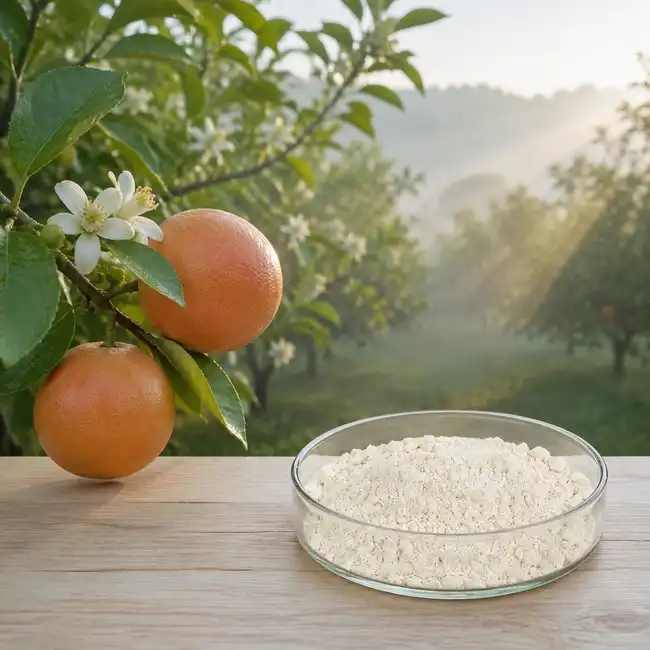
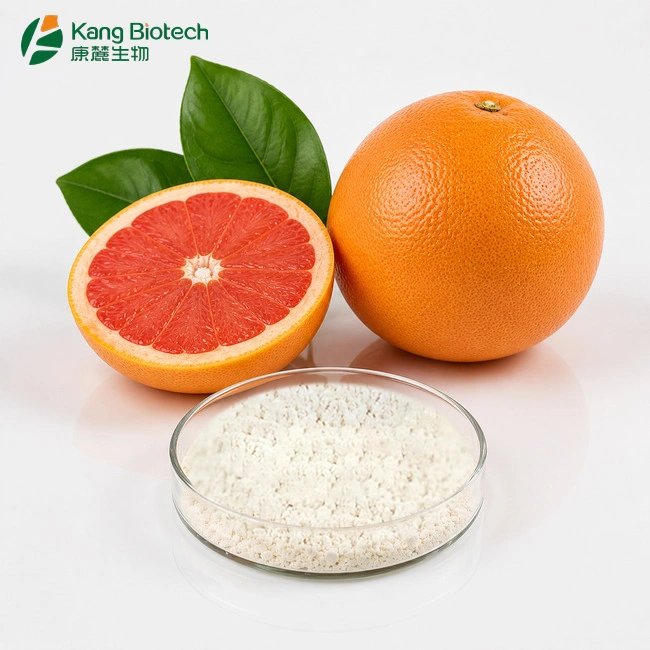
Naringin makes fruits taste sharp and bitter, like grapefruit and bitter orange. The taste changes because of small changes in the chemicals. When you add a strong base to naringin and then use a catalyst to add hydrogen, the chemical changes into naringin dihydrochalcone. Back in the 1960s, the U.S. government found this group of sweet compounds. Office of Farming. To make citrus juice taste less bitter, they looked for ways to make it. It comes in molecular form and weighs 582.55 grams. Its formula is C27H34O14. Nasperidin dihydrochalcone has the CAS number 20702-77-6, while this one is 18916-17-1. Check the CAS number on all of your specs, COAs, and quotes to make sure they don't get mixed up.
Sweetness Strength and Sensory Profile
There is 500 to 700 times more sugar in our naringin dihydrochalcone powder than in sucrose. Remember that the ratio changes based on the base, the concentration, and the temperature if you want to start with one. It's sweet and has a hint of licorice that lingers in your mouth. Those notes can improve the taste of tastes that are too sharp or metallic. It also means that a lot of it can make you feel heavy, which is why most formulators mix it with another sweetener and keep the dose low. There are more than one way to find out what you need to know. You can have a bench trial at your own base. Ask a small group of people who have never tried it before to rate each dose on how strong, sweet, bitter, and long-lasting it is.
How It Compares with NHDC, Stevia and Sucralose
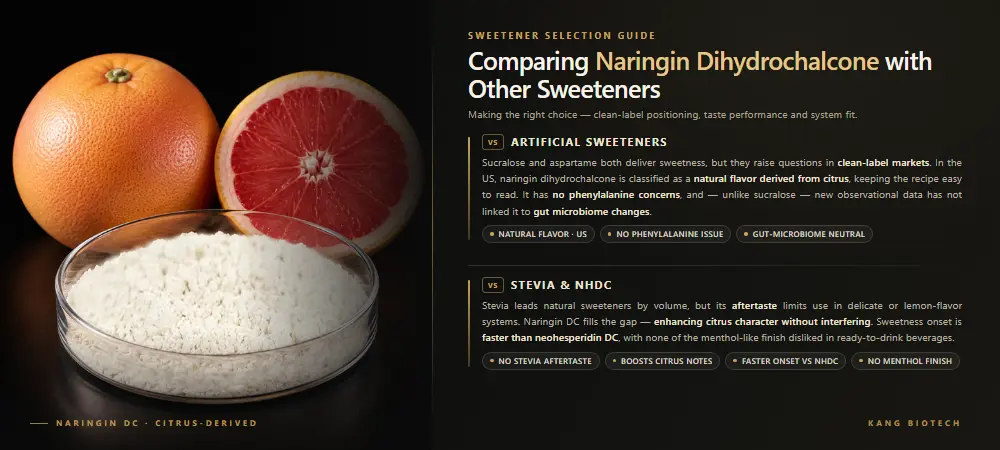
It's also known as nasperidin dihydrochalcone (NHDC). There are about 1,500 to 1,800 times more sugar in it than in sucrose, so it's heavier. When you want a masking effect that drinkers won't notice, naringin dihydrochalcone is milder and allows for more precise control. A lot of people say that NHDC's finish smells like menthol, but our data sheet's finish sounds better. But you should try both in your base first before making your choice. The bitter and metallic taste of stevia extracts can be less strong when naringin dihydrochalcone is added to them. There are different kinds of sucralose with different names, prices, and ways of being made. What you choose will depend on what you need, how much it costs, and the market rules where you live.
Naringin Dihydrochalcone Uses and Benefits Across Product Categories
Beverages and Dairy
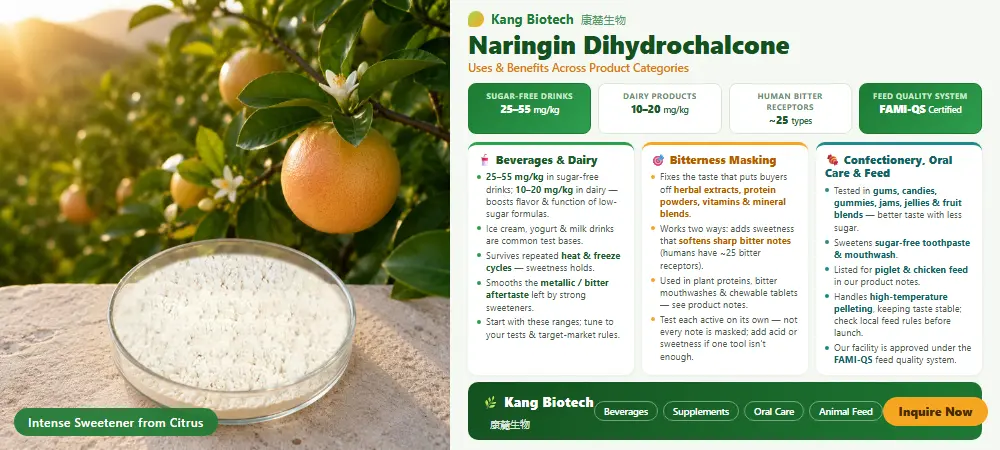
Naringin dihydrochalcone is typically used in doses of 25 to 55 mg per kg in sugar-free drinks and 10 to 20 mg per kg in dairy products to improve the flavor and functionality of sugar-free and low-sugar drinks. That's why ice cream, yogurt, and milk drinks are often used as test bases. You can heat and freeze the powder several times, and it will still be sweet. Because the sweetness lasts, it can smooth out the metallic or bitter aftertaste that some strong sweeteners leave behind. Start with these ranges. You can compare the last levels to the tests you've already done and the rules in the market you want to get to.
Bitterness Masking in Supplements, Plant Proteins and Pharmaceutical Products
People often don't want to buy herbal extracts, protein powders, vitamins, or mineral blends because they taste bad. Two different ways that Naringin dihydrochalcone can help. It makes the bitter notes less sharp by adding some sweetness. There are about 25 different kinds of bitter taste receptors in people. This is possible with compounds, but the way they do it is different for compounds and bases. It says on the back of the package that it can be used to make plant proteins, bitter mouthwashes, and chewable tablets. Check each one on its own because not all of the actives will be hidden. Add taste, acid, or sweetness to the tool if one isn't enough. That's why the trial for masks should come first.
Confectionery, Oral Care and Animal Feed
Gums, candies, gummies, jams, jellos, and fruit mixtures have all been tested for naringin dihydrochalcone. When you use little amounts, it tastes better and has less sugar. People use it to add sweetness to toothpaste and mouthwash that don't have sugar. We also list food for piglets and chickens in our product notes. It helps keep the taste stable to be able to handle pelleting at high temperatures. Before you plan a launch, check the rules in your area to see what the feed rules are. Famili-QS, a quality system for feed and specialty ingredients, has given the go-ahead for our building. There is a way to solve all of them. Try a little at a time and see how it tastes before you judge it in plain water.
Naringin Dihydrochalcone Formulation, Safety and Regulatory Checks
Solubility, Stability and Handling
We sell off-white to white powder. The pieces are 80 to 100 mesh, which makes them easier to mix. Many teams mix naringin dihydrochalcone with warm water or a carrier before adding it to a batch. This is because warm water or a carrier works better than cold water. Up to 160°C, it stays stable, which is hot enough for most of the steps in baking and pelleting. The powder has some water in it. If you keep it closed, cool, dry, dark, below 25°C, and with 60% humidity, it won't clump. If you store it that way, it will last for 24 months. Before it goes on sale, after it has been frozen and thawed, and after it has been pasteurized or hot filled, test it to make sure it is still good. Pay attention to the taste, the smell, the color, the droplets, the active ingredients, and the taste.
Dosage and Bench Testing
Some things don't work after just one dose. In our notes, we write down 10 to 20 mg per kg for dairy, 25 to 55 mg per kg for sugar-free drinks, and 20 to 50 ppm for strong food. The provider can give you those numbers. They don't follow the rules. Start with a little amount and add to it over time. At each step, have everyone rate how sweet, bitter, and long-lasting it is. Mix naringin dihydrochalcone with sugar, stevia, or sucralose after that. You need to know both the price per kilogram and the cost-in-use for each dose.
Safety and Regulatory Checks for the U.S. Market
What is safe to use depends on the market, the product, and the amount that comes in. Don't think that just because a sweetener is regulated that it is the same as another one. For this compound to be used in the U.S., you need to make sure it is GRAS and on the flavor listing list for the job you want to do. They can also tell you how labels should be made. It is important to know how to add neohesperidine dihydrochalcone (E 959) in the EU. Check those numbers first if you want to use them for naringin dihydrochalcone. In 2022, the EFSA took another look at it. An allergen review and a check for contaminants are also part of the safety review. This is not the same as getting permission from the law. You should ask for the allergen statement, the data sheet, the results for heavy metals and microbes, and information about the solvent that is still there.
Buying Naringin Dihydrochalcone from Kang Biotech
Product Specification and Quality Control
Kang Biotech has been making herbal medicines since 2011. In Lianyuan, Hunan Province, we are in charge of bitter orange farms that cover more than 20,000,000 m² and a factory that covers 33,000 m² and has 9 production lines. Our naringin dihydrochalcone powder has an HPLC score of 98% and is safe for food. It is made by first extracting it with water or ethanol and then heating it up to make hydrogen. There are HPLC purity tests, ICP-MS heavy metal tests, and microbial tests for E. coli and Salmonella on every batch. These groups have given their approval to our systems: ISO 9001, ISO 22000, HACCP, Halal, Kosher, and FAMI-QS. We share a research center with the Hunan Institute of Agricultural Product Processing and Quality Safety. This center helps us with our work on products and extraction. We keep an eye on the raw materials for every batch because we run the plantations and the plant.
MOQ, Packaging and Shipping
We always have stock on hand. You can try small amounts, and 1 kg is the least you can order. FedEx delivers small packages, but bigger orders are sent by air or sea. A fiber drum with a polyethylene liner is usually used to pack 25 kg. We can label and package your products and make them just the way you want them. This is called OEM and ODM work. Sometimes this set-up will work in two situations. To get a sample for their lab work, they don't need to make a big order. Once they know the best way to ship the package and its size, they can plan where to make it. We'll help you get where you need to go. Please tell us the time, how many people are going, and where you want to go. If you order 1 kg of naringin dihydrochalcone as a test, you can see how the powder works in your own base before you buy more.
A Short Checklist before You Approve a Supplier
Structured checks make things safer for people who are in charge of buying things. First, pick the goal, level, amount, and users. Then ask for a COA for a recent batch, the RMS, the spec sheet, and other paperwork that proves you are following the rules. Check out CAS 18916-17-1 and ask what HPLC method works with that purity number. You can try a little in your base to see how sweet, soluble, and hideous it is. Don't just look at the weight price. Check the MOQ, lead time, freight, packaging, and payment terms as well. Find out about long-term supply, change control, and seeing your batches if you want to place more than one order. A direct manufacturer can answer these questions right away, so your lab doesn't have to wait as long for the production team to get back to them. Each question must be written down and answered by someone who sells naringin dihydrochalcone.
Conclusion
Naringin dihydrochalcone is made by adding hydrogen to naringin. It comes from citrus fruits. It tastes like licorice and is 500 to 700 times sweeter than sucrose. A small amount of it is used to lower the amount of sugar and bitterness in dairy, sweets, oral care products, and feed. It's not as strong as NHDC, which has better control but doesn't test everything. There are people in charge of each market who check the drug before it goes on sale and do tests to make sure it is stable. This is because the base changes the dose. Things that have been checked out will help you make good decisions. Some of these are the CAS number, the purity of the HPLC, the data on heavy metals and microbes, and the samples that were tested in the real formulation. For products that need to regulate the amount of sweetness and bitterness, naringin dihydrochalcone is helpful.
FAQ
1. What is the minimum order for naringin dihydrochalcone powder?
You can try small amounts, and 1 kg is the least you can order. Your lab can test how well the sweet and bitter tastes go together before you order a lot. FedEx delivers small packages, but big orders are moved by air or sea. Every fiber drum has 25 kg of stuff packed on it. Labeling and packing that are made just for you are part of the OEM or ODM service.
2. Is naringin dihydrochalcone the same as NHDC?
They're not the same. NHDC has the CAS number 20702-77-6 and naringin dihydrochalcone has the CAS number 18916-17-1. Naringin dihydrochalcone is 500–700 times sweeter than sucrose, according to what we know. However, NHDC is rated between 1,500 and 1,800 times most of the time. Also, there may be more than one way to control different compounds, so check each one separately before you make the formula.
3. How should I store the powder, and how long does it last?
Put it somewhere cool, dry, dark, below 25°C, and with 60% humidity. Close it up. The powder won't stick together as long as the humidity stays low. It will be able to flow easily. If you keep it this way, it will last 24 months. Close the liner back up tight every time you use it.
Request Naringin Dihydrochalcone Samples and Quotes from Kang Biotech
Want to find a company that sends out 1 kg samples and 25 kg drums of naringin dihydrochalcone? Kang Biotech has 98% HPLC powder that is safe for food in stock and can ship it by FedEx, air, or sea. They also do OEM and ODM work. Tell sales02@kangbiotech.com what you need, how much you need, and where the product needs to go. Our team will tell you more, give you a COA, and give you a quote. To learn more, go to cnkangbiotech.com.
References
1. Horowitz, R. M., and Gentili, B. "Taste and Structure in Phenolic Glycosides." Journal of Agricultural and Food Chemistry, 1969.
2. DuBois, G. E., and Prakash, I. "Non-Caloric Sweeteners, Sweetness Modulators, and Sweetener Enhancers." Annual Review of Food Science and Technology, 2012.
3. Meyerhof, W., et al. "The Molecular Receptive Ranges of Human TAS2R Bitter Taste Receptors." Chemical Senses, 2010.
4. EFSA Panel on Food Additives and Flavourings. "Re-evaluation of Neohesperidine Dihydrochalcone (E 959) as a Food Additive." EFSA Journal, 2022.
5. Ley, J. P., et al. "Evaluation of Bitter Masking Flavanones from Herba Santa (Eriodictyon californicum)." Journal of Agricultural and Food Chemistry, 2005.
6. Benavente-García, O., and Castillo, J. "Update on Uses and Properties of Citrus Flavonoids." Journal of Agricultural and Food Chemistry, 2008.

Send Inquiry
Related Industry Knowledge
- Naringin Dihydrochalcone: Uses, Benefits and Sweetness
- What Is Neohesperidin Dihydrochalcone Used For as a Sweetener?
- How to Choose a Neohesperidin Powder Manufacturer
- What is Neohesperidin Dihydrochalcone?
- Horny Goat Weed: How Long Until You Feel the Effects?
- Exploring Antioxidant Applications of Polymethoxy Flavonoids Powder
- Glucosyl Hesperidin: Rethinking Hesperidin in Drinks
- NHDC Sweetener Guide: How Neohesperidin Dihydrochalcone Is Changing Low-Calorie Foods
- 3 Health Benefits of Horny Goat Weed
- Hesperidin: The Citrus Bioflavonoid that Supports the Brain & Heart