
What Is Neohesperidin Dihydrochalcone Used For as a Sweetener?
November 9, 2026
Flavor and sweetness are improved with Neohesperidin Dihydrochalcone powder, which is used by formulators in very small amounts. A few parts per million can be used to add sweetness to low-sugar drinks, dairy products, candy, supplements, and oral care items. The sweetness is 1,500 to 1,800 times greater than sucrose. It also makes bitter and metallic tastes less strong when mixed with stevia or sucralose. People who read this guide are part of groups that decide what to buy and how to do it. How to test it, where to get it, and what it does are the things they want to know.
What Is Neohesperidin Dihydrochalcone Powder?
Chemical Identity and Source
With a molecular weight of about 612.58 g/mol, neohesperidin dihydrochalcone powder has the formula C28H06O19. The CAS number for it is 20702-77-6. Its US number is 3811 and its EU number is E959. Nyesperidin is a flavonoid that is found in bitter orange. It changes into dihydrochalcone when hydrogen is added. We use a powder that is white to off-white in food. With an HPLC test of 98%, it can be taken out with either water or ethanol. This is why you should always check the most recent COA against the lot's identity and assay.
Sweetness Profile and Taste
NHDC's sweetness builds up slowly and stays with you for a long time. A cool finish that tastes like licorice or menthol is what most people notice when they taste it. This note gets stronger as the dose goes up. But sugar hits hard and goes away quickly. We found that neohesperidin dihydrochalcone powder mostly hides bitterness at levels of 1 to 5 ppm and makes things taste sweeter at levels of 10 to 50 ppm. I believe you should do some short bench presses to find the right level before you make a goal.
What "Natural" Means for This Ingredient
A lot of people who want to buy ask if NHDC is natural. NHDC is not a raw fruit extract; it is a sweetener made from citrus fruits that is made through a chemical process. Citrus fruits are where neohesperidin comes from. There are rules in the market and the needs of the certifier that say "natural" or "organic" printing is allowed or not. Before you buy neohesperidin dihydrochalcone powder for a U.S. label, talk to someone who knows the rules. They can help you write the claim. More than 20,000,000 m² of bitter orange trees are cared for by Kang Biotech in Lianyuan, Hunan. It's now clear where we can get the raw materials.

How Does Neohesperidin Dihydrochalcone Powder Work, and Where Do Formulators Use It?
Sweetener and Flavor Modifier
NHDC does two things. Since it's a sweetener, it gives you a little sweetness with almost no calories. It also won't change your blood sugar or cause cavities. Plant extracts, protein supplements, and drug actives taste different because it lessens the bitterness of them. Neohesperidin dihydrochalcone powder is purchased by many teams for the second task. A protein drink with a harsh aftertaste might taste better with a few parts per million added.
Blending With Stevia, Sucralose, and Others
Blends are used a lot in business. When you mix stevia and sucralose, the aftertaste should be smoother. Stevia can have a bitter or licorice-like aftertaste. The sweetness curve can be made longer by adding a little neohesperidin dihydrochalcone powder to those places. As much as 40% more sweetness can be added if you mix NHDC with sugar alcohols or acesulfame-K. What this means is that you might be able to use less sugar overall. That number is where I begin when I work with various acid types and tastes. Look at a level ladder and write down the tastes at the beginning, the peak, and the end.
Main Uses Across Product Categories
NHDC is used in ready-to-drink teas, sports drinks, carbonated soft drinks, and juices because it doesn't break down in acid. Dairy and frozen foods include fruity milk, yogurt, and ice cream. It's in gum, hard candies, cookies, cakes, and other sweets and baked goods. Protein powders, tablets, and powders are made less bitter by supplement companies by adding neohesperidin dihydrochalcone powder. People who work in the dental field and drug companies use it to make mouthwash, chewable tablets, syrups, and medicines. It varies from market to market on how much is allowed, how the product is categorized, and how it is labeled. Make sure you check all of them before you go live.
What Are the Key Technical Properties and Dosing Rules for Neohesperidin Dihydrochalcone Powder?
Neohesperidin Dihydrochalcone Powder Solubility and Dispersion
NHDC is hard to dissolve in cold water (about 0.5 g/L), but it's much easier to dissolve in hot water and ethanol. This is why a lot of plants make a strong pre-dispersion first and then add it to the batch. How things spread out can be changed by temperature, pH, particle size, stirring, and the order in which they are mixed. There are different kinds of carriers that can help with this job. Use a liquid line to see how fast the powder dissolves in water while you set the tank's temperature. Once the filtering is done, look for spots. The first thing I would check is how the neohesperidin dihydrochalcone powder breaks down.
Heat, pH, and Storage Stability
Based on the tests we conducted, the ingredient remains stable across a wide range of pH levels, making it suitable for use in acidic and neutral beverages, including fruit juices and carbonated soft drinks. In terms of heat resistance, it remains stable during pasteurization, UHT processing, and baking, without losing its sweetness as aspartame does. However, prolonged exposure to light, moisture, oxygen, and pH fluctuations during storage can still affect ingredient stability over time. Therefore, it is important to test the ingredient under the same conditions in which it will be used. Our powder has a shelf life of 24 to 36 months when stored in its original packaging in a cool, dry place. It melts at 156–158°C, and its weight loss after drying is less than 12%.
A Practical Dosing Workflow
There are some things that don't work in one dose. The amount depends on kind of food, its bitterness, method of preparation, type of sweetener used and norms of the region. I concur with this order. The first thing to do is to get a control sample. Hide things with low concentrations in the range of 1 to 5 ppm. Add 10 to 50 ppm for improved flavour. With a panel you may score how sweet it is first, how long it lasts, how effectively it covers up the bitterness and how long it lasts after the taste. Pre-mix the powder and add a little at a time, since it may react with acids, minerals, plants, proteins and preservatives. One more thing: make sure the dosage works at the tiny size.
Is Neohesperidin Dihydrochalcone Powder Safe, and How Does It Compare With Other Sweeteners?
Regulatory Status for U.S. Buyers
I inspect each region individually since the level of safety varies depending on the market. In the EU, tobacco NHDC (E959) is not prohibited by legislation. It was reviewed again by the EFSA in 2022. In the US, FEMA has assigned NHDC the GRAS number 3811. The FDA's GRAS Notice Inventory states that NHDC will be authorised without any difficulties in 2020, with the number 902. Ensure that references cover your category, usage level and materials criteria. A provider, like us, should offer you the supporting documents and you should then go over them with a regulatory counsel.
Documents to Request Before Approval
- Identity and quality data: Batch-specific COA listing batch number, test dates, HPLC assay, appearance, loss on drying, and expiration or retest date, as well as technical data sheet and SDS. We specify that lead must be less than 3mg/kg; arsenic less than 2mg/kg; and total plate count less than 1,000cfu/g.
- Compliance declarations: allergy and non-GMO statements as applicable, residual-solvent declaration and copies of current quality-system certifications. We are certified to ISO 9001, ISO 22000, HACCP, Halal, Kosher and FAMI-QS. Attach each certificate to the location that produces your goods and verify the expiration date before approving the supplier officially.
- Regulatory support: FEMA and E-number citations, plus any GRAS notice citation that backs up your U.S. usage. Ask for it in writing Just because it's a citrus doesn't make it okay. Food grade material has to be qualified independently before anybody can utilise it in a medicinal product. Keep the lot record documents so your staff can track each claim.
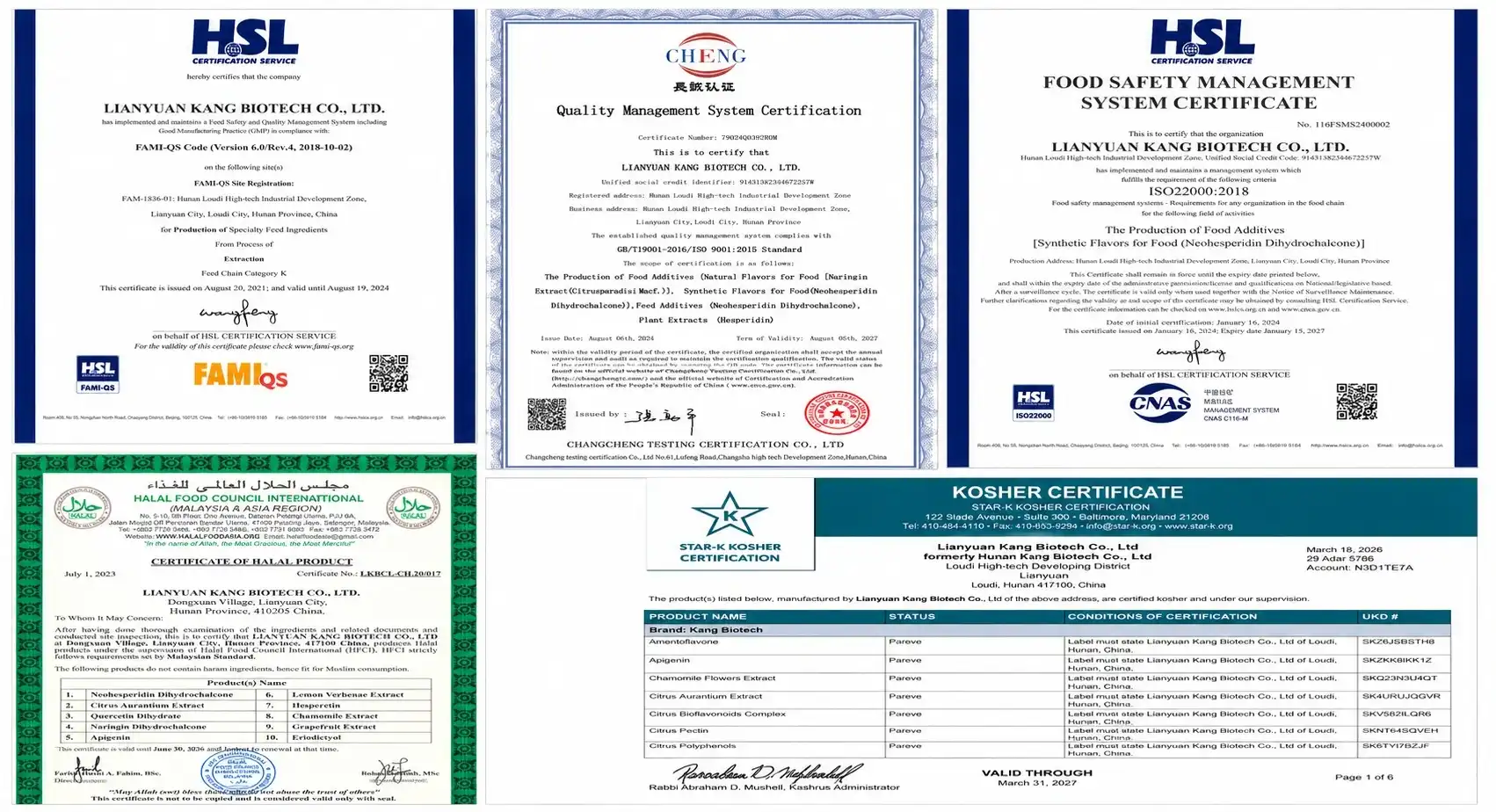
Get the whole pack. Your quality team will be able to compare lots over time, and the audit of your supplier will go faster.
Neohesperidin Dihydrochalcone Powder Compared With Stevia, Sucralose, and Naringin Dihydrochalcone
Stepia is made from the leaf. It could taste bitter or like licorice if you take more of it. Cl-sucrose in this form is easy to mix with other things and is often used in drink mixes. The neohesperidin dihydrochalcone powder changes the taste more than it makes it sweeter. It also makes it sweeter more slowly and for a longer time. Berries have a chemical called naringin dihydrochalcone that is similar to this one. In your own matrix, you can compare where it comes from, how it tastes, and how it is put together. You shouldn't just look at the price per kilogram when you look at NHDC. Most of the time, cost-in-use doesn't tell the whole story.
How Should You Choose and Buy Neohesperidin Dihydrochalcone Powder in Bulk?
Match Purity and Specifications to Your Application
You should use a powder that is safe for food and has a 98% HPLC test and a COA that your lab can check. Food and drinks should be able to go in it. To be sure the test was done right, your team can use HPLC-UV at 282 nm. Figure out how big the pieces are. Fine powder is more likely to spread out faster. Check out the lead time, the minimum order size, the shelf life, and the way the product is packed. We offer samples and all orders come in 25 kg drums. It is possible to place a test order for as little as 1 kg. Find out how the company lets customers know when things change. This neohesperidin dihydrochalcone powder should be used for more than one SKU. It is important to make sure that each lot meets the same requirements.
Bulk Quotes and Cost-in-Use
Some of the things that a good quote will tell you about a product are its purity, grade, quantity, packaging, Incoterms, destination, payment terms, lead time, and how it will be shipped. Find out how much it costs to use instead of how much it costs per kilogram. This includes the effective dose, the cost of shipping, customs, testing, storage, and the chance that a new formula will need to be made. Neohesperidin dihydrochalcone powder can be used to make many finished goods, so the quantity you require may be more important than the price. Before you place a big order, ask for a lab sample and then a pilot order. When we have small orders, we use a fast courier service. For big jobs, we fly or sail. When they get there, check the drums and write down any damage you see.
Working With a Direct Manufacturer
Kang Biotech has been around since 2011 and has nine production lines spread out over 33,000 m². Our tech team has been getting juice from citrus fruits for more than 20 years. We have a research center that we run with the Hunan Institute of Agricultural Product Processing and Quality Safety. People from more than 40 countries come to us for goods. We can also change the specs, label, and package the items in a way that works for you as an OEM or ODM service. Making sure you know how to complain, get a replacement, or get your money back is important when you check out any supplier. Check the certificates, ask for up-to-date COAs, make sure you know the capacity and lead times, and learn how to file a complaint.

Conclusion
Neohesperidin Dihydrochalcone powder at ppm levels reduces bitterness in beverages, dairy, confectionery, vitamins and oral care items and offers plenty of sweetness without any calories. Slow to start and long lasting, it works nicely with stevia or sucralose. Bench and pilot testing select the final dosage whereas standard because they illustrate how the product functions. This is the first stage in ensuring something is stable: spread it out and verify its stability in the manner that it will be utilised and stored in real life. However, as each market has different standards, the clearance procedure should contain batch-specific forms and use-specific references. So, pricing per kilogram is not the greatest means to figure out how much an item costs when it is utilised. Use assay, COA data, certificates and cost-in-use instead.
FAQ
1. Is NHDC a high-intensity sweetener?
Yes. Because it is 1,500 to 1,800 times sweeter than sucrose, it is only used in very small amounts.
2. Does neohesperidin dihydrochalcone powder dissolve in water?
It's not very much—about 0.5 g/L in cold water. It breaks down faster in hot water and ethanol, so many plants spread it out first.
3. What dose should I start with?
We know that between 1 and 5 ppm can hide bitterness and between 10 and 50 ppm can make it sweeter. Tests on the bench and limits in each area set the levels.
4. How should I store it?
Make sure the lid is on the box and keep it somewhere cool and dry. It's good for 24 to 36 months.
5. Which documents should I request?
Ask for a batch COA, TDS, SDS, quality certificates, and written regulatory references that are related to the use you want to make.
6. What is the minimum order?
You can get samples, and 1 kg is the least you can order.
Request a Neohesperidin Dihydrochalcone Powder Sample or Bulk Quote From Kang Biotech
Kang Biotech makes its own neohesperidin dihydrochalcone powder, so it has a lot of it in stock and samples ready to test in the lab. The smallest amount you can order is 1 kg. Tell sales02@kangbiotech.com what kind of product you want, who you want to sell it to, how pure it needs to be, how much you need each year, and how you'd like it to be packed. That's when we'll send you the quote, the COA, the spec sheet, and the SDS. When we have small orders, we use a fast courier service. We ship it by air or sea when you buy a lot. To learn more, go to cnkangbiotech.com.
References
1. EFSA Journal, 2022 – Re-evaluation of neohesperidine dihydrochalcone (E 959) as a food additive
2. U.S. Food and Drug Administration, GRAS Notice Inventory, 2020 – GRN No. 902, Neohesperidin dihydrochalcone
3. Official Journal of the European Union, 2008 – Regulation (EC) No 1333/2008 on food additives
4. Official Journal of the European Union, 2012 – Commission Regulation (EU) No 231/2012 laying down specifications for food additives
5. Alternative Sweeteners, 3rd Edition, 2001 – Chapter on neohesperidine dihydrochalcone by Borrego and Montijano
6. Journal of Agricultural and Food Chemistry, 1969 – Horowitz and Gentili, "Taste and structure in phenolic glycosides"

Send Inquiry
Related Industry Knowledge
- What Is Neohesperidin Dihydrochalcone Used For as a Sweetener?
- Neohesperidin Powder vs Hesperidin: Key Differences Explained
- How to Use Naringenin Powder in Dietary Supplements
- Glucosyl Hesperidin: Rethinking Hesperidin in Drinks
- 4 Benefits of Naringin For Your Health
- 3 Health Benefits of Horny Goat Weed
- Naringenin Powder in Dietary Supplements: Formulation Guide
- Exploring Hesperetin Powder for Modern Cosmetic Formulation
- What Is Naringenin Powder and How Is It Used?
- What Is Apigenin Powder and Why Is It Gaining Popularity in Supplements?