
Glucosyl Hesperidin vs Rutin: Solubility and Functional Differences
November 20, 2026
Glucosyl hesperidin dissolves in water far more readily than rutin, so it suits clear beverages and other liquid formulas, while rutin stays practical in capsules, tablets, and dry blends. Kang Biotech's glucosyl hesperidin powder dissolves at more than 50 g per 100 mL at room temperature, compared with 0.01 g per 100 mL for native hesperidin. Rutin also dissolves poorly in water. Both plant flavonoids appear in antioxidant and circulation-support products, yet their evidence, stability, and documentation differ. I wrote this guide to help formulators and buyers choose between them and plan a fair test before ordering.
Poor solubility causes real trouble in flavonoid projects. It affects dispersion, dosage uniformity, sensory quality, and processing time. The sections below compare the two ingredients on chemistry, solubility, function, application, documentation, and purchasing, so you can plan a pilot test with fewer surprises.
Glucosyl Hesperidin and Rutin: Basic Chemical and Functional Profiles
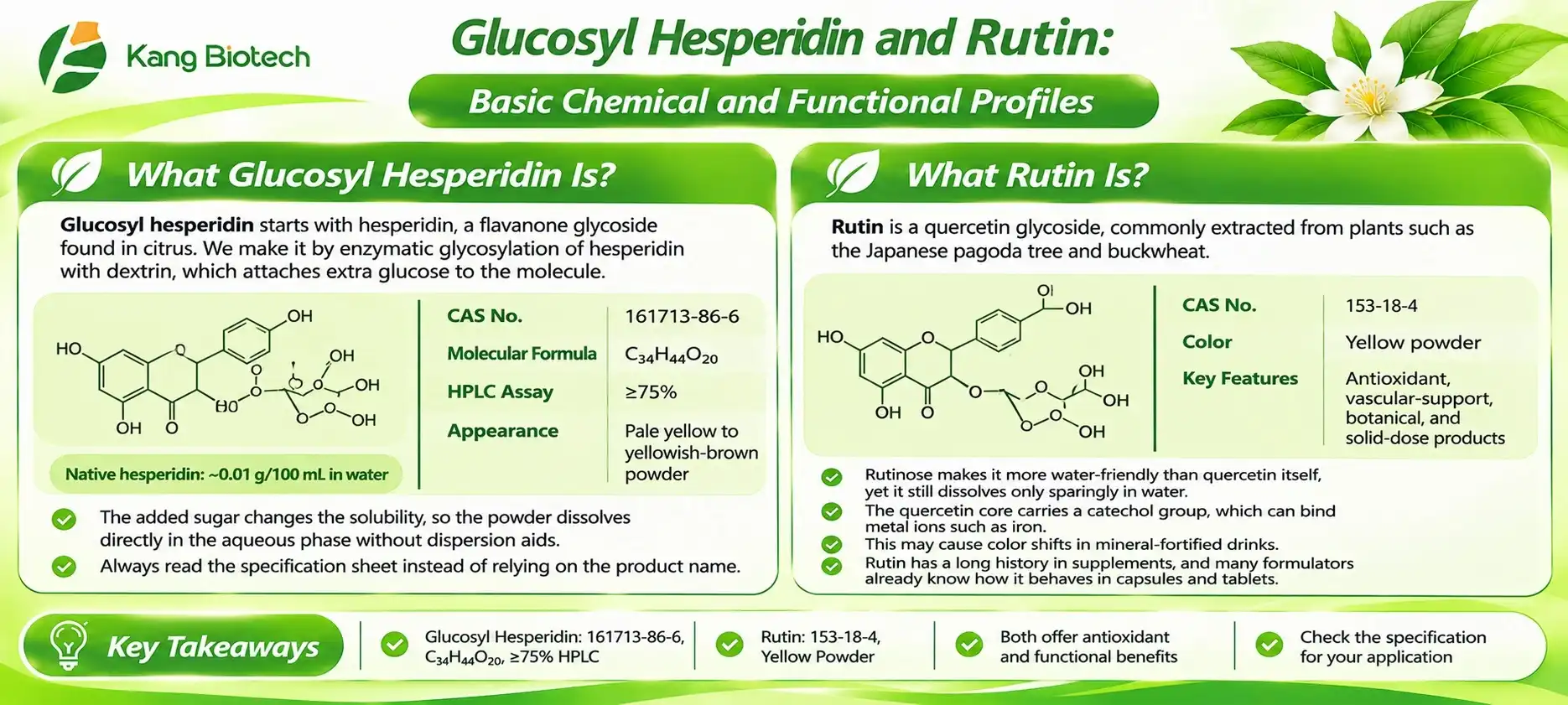
What Glucosyl Hesperidin Is?
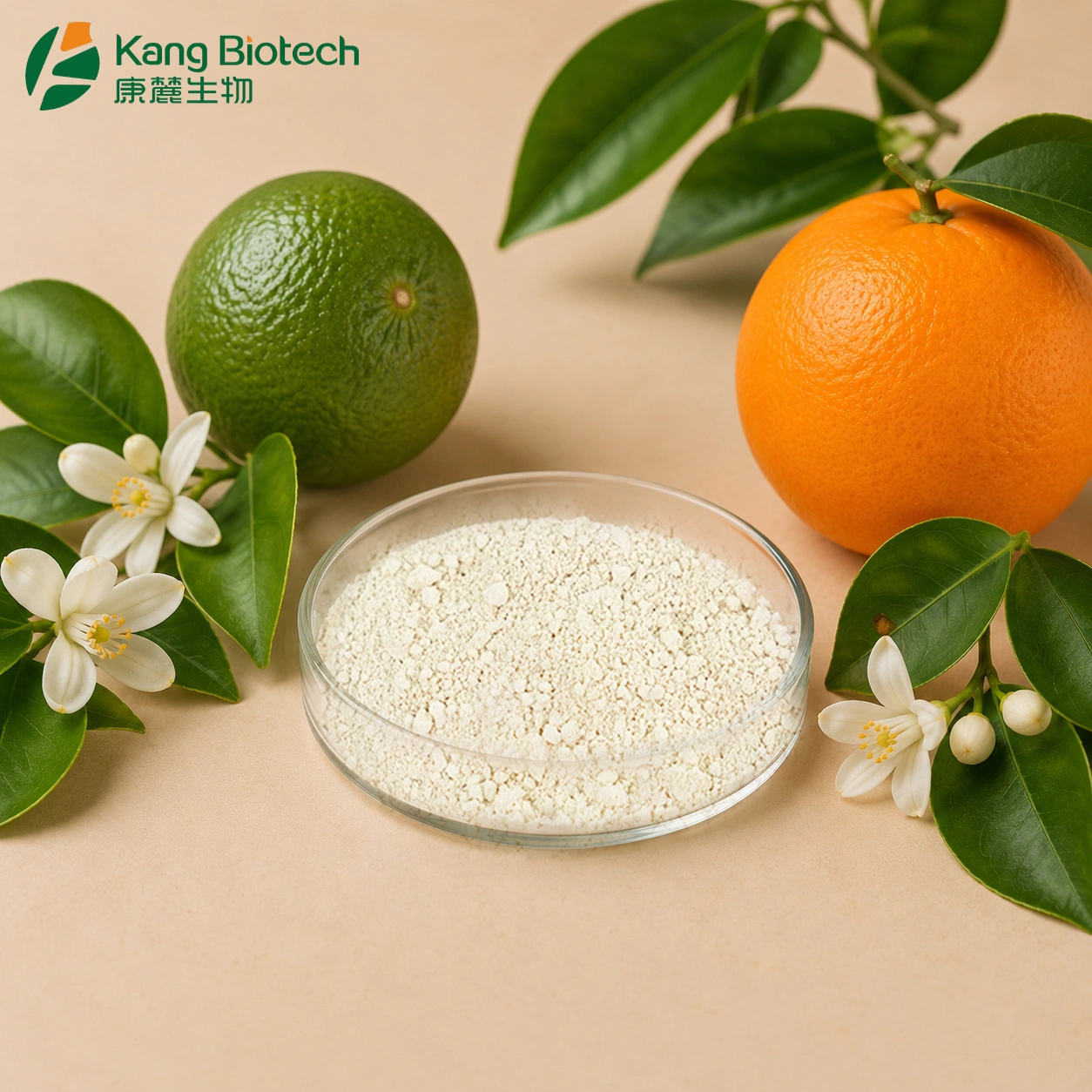
Glucosyl hesperidin starts with hesperidin, a flavanone glycoside found in citrus. We make it by enzymatic glycosylation of hesperidin with dextrin, which attaches extra glucose to the molecule. The powder carries CAS No. 161713-86-6 and the molecular formula C34H44O20. Our food grade specification is 75% HPLC, and the appearance is a pale yellow to yellowish-brown powder. Native hesperidin barely dissolves in water, at about 0.01 g per 100 mL. The added sugar changes that behavior, so the powder dissolves directly in the aqueous phase without dispersion aids. Always read the specification sheet instead of relying on the product name.
What Rutin Is?
Rutin is a quercetin glycoside with CAS No. 153-18-4. Manufacturers commonly extract it from plants such as the Japanese pagoda tree and buckwheat. It is a yellow powder, and suppliers sell it for antioxidant, vascular-support, botanical, and solid-dose products. Its sugar part, rutinose, makes it more water-friendly than quercetin itself, yet it still dissolves only sparingly in water. The quercetin core carries a catechol group, and that group can bind metal ions such as iron. This matters in mineral-fortified drinks, where color shifts can appear. Rutin has a long history in supplements, so many formulators already know how it behaves in capsules and tablets.
Why Labels Need a Second Look?
Terms such as "natural," "water-soluble," and "high bioavailability" describe marketing, not chemistry. Two glucosyl hesperidin products can differ in assay, carrier content, and residual hesperidin. Two rutin products can differ in botanical source, hydrate form, and particle size. When I compare suppliers, I look at the assay method, the reporting basis, moisture, and test conditions. A fair comparison uses the same purity basis for both ingredients. Otherwise, a 75% powder and a 95% powder will appear to perform differently for reasons unrelated to chemistry. Ask for the certificate of analysis first, and treat brochures as a starting point.
Solubility and Bioavailability: The Core Difference
Water Solubility in Numbers
Our glucosyl hesperidin powder dissolves at more than 50 g per 100 mL in room-temperature water. That is about 5,000 times the solubility of native hesperidin. Rutin tells a different story. Published values vary with temperature and hydrate form, but at room temperature they stay below one gram per liter. Beverage makers who want rutin in a liquid usually need micronization, suspension systems, or other carriers. For a clear drink, that gap decides whether the ingredient is practical at all. Check any solubility claim against its stated temperature, pH, and mixing time before you trust it.
What Animal and Human Data Say About Absorption
Solubility helps dissolution, but absorption involves more steps. A 2006 rat study in Bioscience, Biotechnology, and Biochemistry reported better bioavailability for glucosyl hesperidin than for hesperidin. For rutin, a 1997 human study in FEBS Letters found that quercetin from onion glucosides absorbed more readily than quercetin from rutin. Gut bacteria must remove rutin's sugar before absorption can proceed. I treat these results as directional, not as proof that one ingredient wins in every product. Dose, dosage form, and the rest of the formula all change the outcome, so strong claims need product-specific data.
How to Test Solubility Fairly
Run the comparison under identical conditions. Use the same temperature, pH, concentration, mixing time, and filtration step for both powders. Then measure what stays in solution by HPLC instead of judging by eye, because a hazy or suspended sample can look uniform. Add a short storage test in your actual base, such as your acidified beverage, and check for sediment after several days. Our quality routine for each batch includes HPLC purity, residual hesperidin content, and solubility verification. I suggest asking every supplier for equivalent data.
Functional Differences and Application Fit
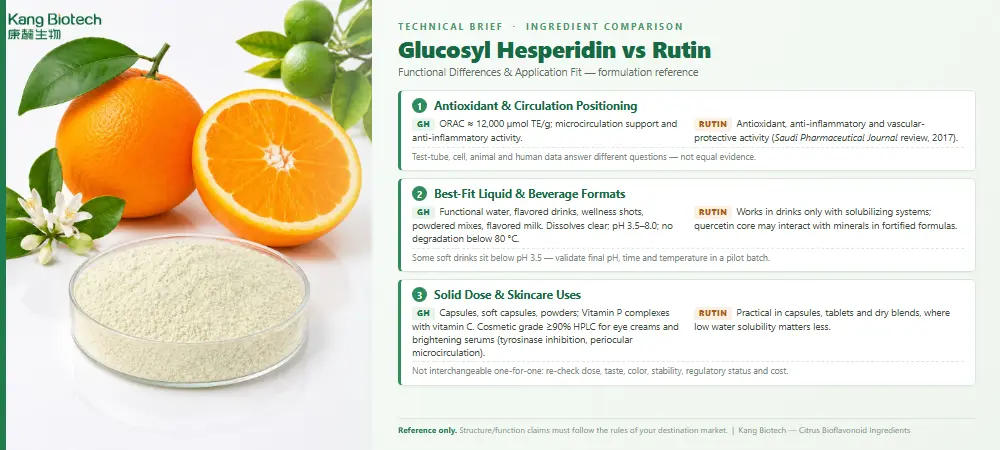
Antioxidant and Circulation Positioning
Both ingredients appear in antioxidant and vascular-support products. Literature cited for glucosyl hesperidin lists an ORAC value of about 12,000 μmol TE per gram, microcirculation support, and anti-inflammatory activity. A 2017 review in Saudi Pharmaceutical Journal describes antioxidant, anti-inflammatory, and vascular-protective activity for rutin as well. Test-tube antioxidant assays, cell studies, animal work, and human trials answer different questions, so I never treat them as equal evidence. This information is for reference only. Any structure or function claim must follow the rules of your destination market.
Best-Fit Liquid and Beverage Formats
Glucosyl hesperidin suits functional waters, flavored drinks, wellness shots, powdered drink mixes, and flavored milk, because it dissolves without clouding the drink. Its pH stability range is 3.5 to 8.0. Some soft drinks sit below pH 3.5, so test the actual formula at its final pH. Our data show no degradation below 80°C. Hot-fill and pasteurization schedules vary, so I recommend validating your own time and temperature profile in the pilot batch. Rutin can work in drinks only with added solubilizing systems, and its quercetin core may interact with minerals in fortified formulas.
Solid Dose and Skincare Uses
Rutin remains practical in capsules, tablets, and dry blends, where low water solubility creates fewer problems. Glucosyl hesperidin also works in capsules, soft capsules, and powdered supplements, and formulators use it in Vitamin P complexes alongside vitamin C. In skincare, our cosmetic grade (≥90% HPLC) goes into eye creams and brightening serums, where published research points to tyrosinase inhibition and periocular microcirculation. Check local rules before you write any claims. If you switch from rutin to glucosyl hesperidin, re-check dose, taste, color, stability, regulatory status, and cost, because the two are not interchangeable one-for-one.
Quality, Documentation, and Regulatory Evaluation
Documents to Request
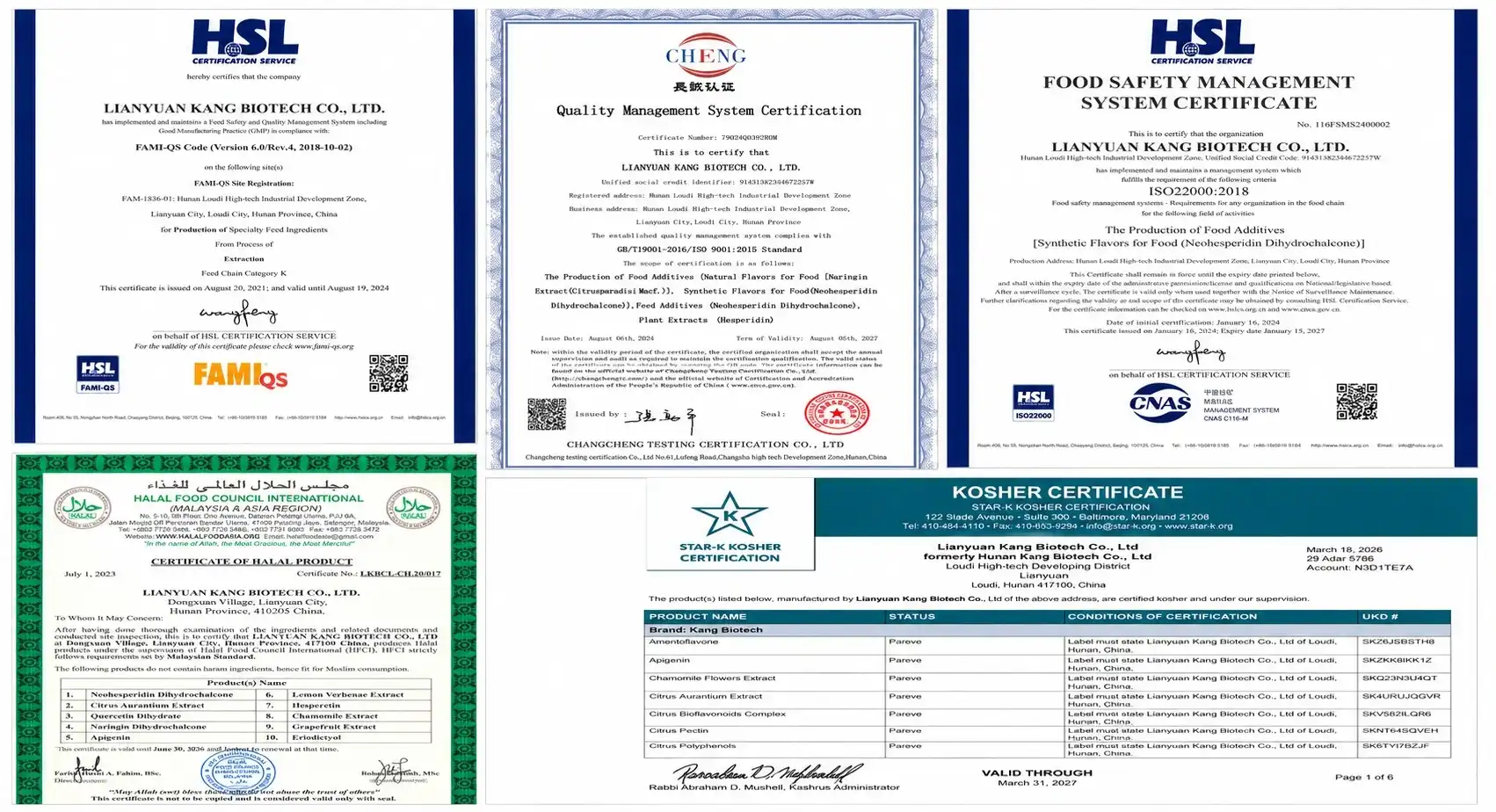
A fair comparison starts with paperwork. For glucosyl hesperidin, ask for the certificate of analysis, specification sheet, safety data sheet, and technical data sheet. The COA should show HPLC assay, residual hesperidin, heavy metals (lead, arsenic, mercury, and cadmium by ICP-MS), total plate count below 1,000 CFU/g, and solubility verification. Our facilities hold ISO 9001, ISO 22000, HACCP, Halal, Kosher, and FAMI-QS certifications. For rutin, ask for the botanical source, extraction solvent, particle-size grade, and identification method. Request data from more than one production lot so you can judge batch consistency yourself.
Regulatory Status for the U.S. Market
Regulatory status depends on the ingredient, the country, and the intended use. Our glucosyl hesperidin holds Novel Food Ingredient approval in China with a recommended intake of up to 500 mg per day, and it appears in China's Catalog of Used Cosmetic Ingredients. Those listings do not replace a U.S. review. Before a U.S. beverage or supplement launch, I advise your regulatory team to confirm the exact ingredient's status for your intended use, including whether any existing GRAS notice covers it. Rutin has its own status, which also needs checking. We provide documents on request to support that review.
Common Mistakes in Comparisons
Four mistakes show up often. First, buyers treat water dispersibility as true solubility, although a suspension can look uniform. Second, they compare products with unequal purity or assay bases. Third, they assume in vitro antioxidant scores predict clinical results. Fourth, they judge by price per kilogram alone. Total cost also includes excipients, processing time, rejected batches, qualification effort, and shelf-life performance. A cheaper powder that needs a suspension system can cost more per finished bottle than a pricier powder that dissolves directly. Write acceptance criteria and test methods into the pilot plan before sampling starts.
How to Choose and Buy: A Practical Checklist
Start With Your Finished Format
Choose by format before price. If your product must dissolve completely, such as a clear beverage, a shot, or a serum, glucosyl hesperidin deserves a trial first. If you press tablets or fill capsules, rutin may meet your needs with less complexity. Then set your critical quality attributes: assay, particle size, moisture, color, odor, stability, and microbial limits. Test dissolution, sedimentation, taste, assay recovery, and compatibility with your acids, minerals, flavors, and preservatives. A bench pilot catches most compatibility problems before scale-up and gives your QA team real data to review.
Supplier Questions That Matter
Confirm whether the company manufactures the ingredient or resells it. Kang Biotech is a direct manufacturer, founded in 2011, with a 33,000 m² facility and 9 production lines. Ask any supplier about capacity, certifications, traceability, export experience, and technical support. On commercial terms, cover MOQ, packaging, lead time, delivery, payment, and pricing tiers. Our food grade glucosyl hesperidin ships in 25 kg drums from stock, with a 1 kg MOQ. Small orders go by FedEx, and large orders go by air or sea. Samples typically ship within 3–5 business days, and bulk orders typically take 2–3 weeks.

Customization and Pilot Support
Private-label and OEM clients often need more than a catalog item. We offer OEM and ODM service, including custom specifications, packaging, and labeling, along with application guidance from our technical team. Our joint research center with the Hunan Institute of Agricultural Product Processing and Quality Safety supports extraction and quality work. Share your dosage form, intended dose, assay target, pH range, sensory limits, destination market, and annual volume, and we can recommend a grade for your pilot. Food grade is ≥75% HPLC, and cosmetic grade is ≥90% HPLC.
Conclusion
Glucosyl hesperidin and rutin are both plant flavonoids with antioxidant and vascular-support positioning, but they behave differently in a formula. Glucosyl hesperidin dissolves directly in water at more than 50 g per 100 mL, which suits clear beverages and liquids, while rutin dissolves poorly and fits capsules, tablets, and dry blends. Absorption data come from different studies and cannot name a winner alone, so product-specific evidence matters. Stability, regulatory status, and documentation also differ, and a U.S. launch needs its own status check. The sound approach starts with the finished format, compares both ingredients under identical test conditions, and counts total cost instead of price per kilogram. A pilot test in the real formula settles the choice.
FAQ
1. Is glucosyl hesperidin more water soluble than rutin?
Yes. Our glucosyl hesperidin dissolves at more than 50 g per 100 mL at room temperature, while rutin dissolves poorly in water. Compare both under the same temperature and pH.
2. Can glucosyl hesperidin replace rutin in my formula?
Sometimes, mainly in liquids. Re-check dose, claims, taste, color, stability, regulatory status, and cost first, then run a pilot test.
3. Is glucosyl hesperidin stable in heat and acid?
It is stable from pH 3.5 to 8.0 and shows no degradation below 80°C. Validate hot-fill or pasteurization in your own process.
4. Can I get a sample, and what is the minimum order?
Yes. Free samples, typically 10–50 g, ship within 3–5 business days. The MOQ is 1 kg. Each batch includes a COA, and the MSDS and specification sheets are available on request.
Request Glucosyl Hesperidin Samples From Kang Biotech
Kang Biotech is a direct glucosyl hesperidin manufacturer with a 33,000 m² facility, nine production lines, ISO 22000 and FAMI-QS certification, and ready stock. Send your target application, dose, and pH range to sales02@kangbiotech.com, and our team will reply with specifications, a COA, and sample details. We offer OEM and ODM service, a 1 kg MOQ, and FedEx, air, or sea delivery. Visit cnkangbiotech.com for more product information.
References
1. Bioscience, Biotechnology, and Biochemistry, 2006: "Bioavailability of glucosyl hesperidin in rats."
2. FEBS Letters, 1997: "Relative bioavailability of the antioxidant flavonoid quercetin from various foods in man."
3. Saudi Pharmaceutical Journal, 2017: "The pharmacological potential of rutin."
4. Phytotherapy Research, 2001: "Chemistry and pharmacology of the citrus bioflavonoid hesperidin."
5. The American Journal of Clinical Nutrition, 2005: "Bioavailability and bioefficacy of polyphenols in humans. I. Review of 97 bioavailability studies."
6. Journal of Agricultural and Food Chemistry, 2019: "Absorption and metabolic behavior of hesperidin (rutinosylated hesperetin) after single oral administration to Sprague-Dawley rats."

Send Inquiry
Related Industry Knowledge
- How to Select a Bulk Naringenin Powder Supplier
- Retaliating Properties of Naringin: A Mini-Review
- How Neohesperidin Powder Supports Antioxidant Formulations
- Hesperetin Powder: From Citrus Sources to Commercial Applications
- 5 Potential Health Benefits of Apigenin
- Naringenin Powder vs Naringin: Key Differences Explained
- 3 Health Benefits of Horny Goat Weed
- How to Use Neohesperidin Dihydrochalcone Powder in Beverages for a Low-Calorie Boost?
- Naringenin Powder in Dietary Supplements: Formulation Guide
- What Is Apigenin Powder and Why Is It Gaining Popularity in Supplements?