
What Does Apigenin Do to Your Skin?
November 19, 2026
Apigenin is a plant flavonoid that researchers study for antioxidant and inflammation-related activity, which is why apigenin powder is gaining attention in skincare and beauty-from-within products. In laboratory and animal studies, apigenin scavenges free radicals and influences inflammatory signaling in skin cells. Human evidence for visible skin benefits remains limited, so no brand should claim that it removes wrinkles or treats acne. In this article, I explain what the research supports, how formulators work with apigenin powder, and what buyers should check before ordering.
What Is Apigenin Powder and Where Does It Come From?
Chemical Identity and Natural Sources
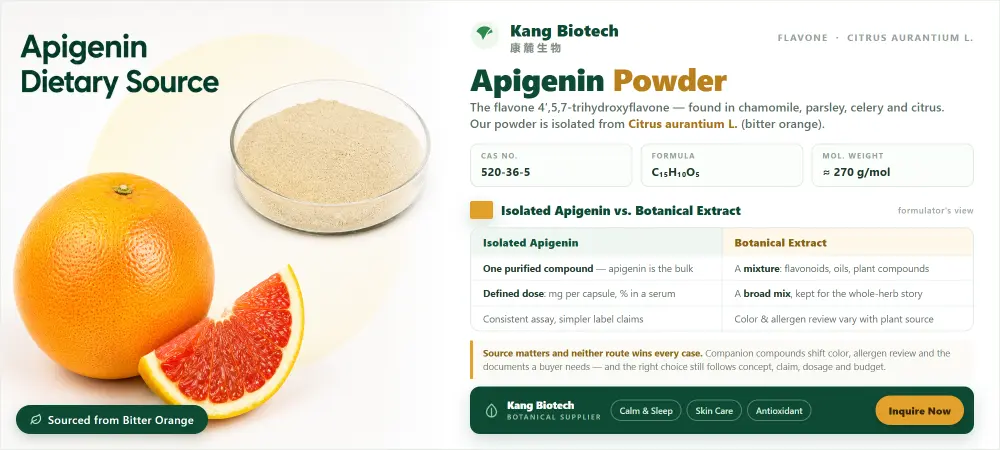
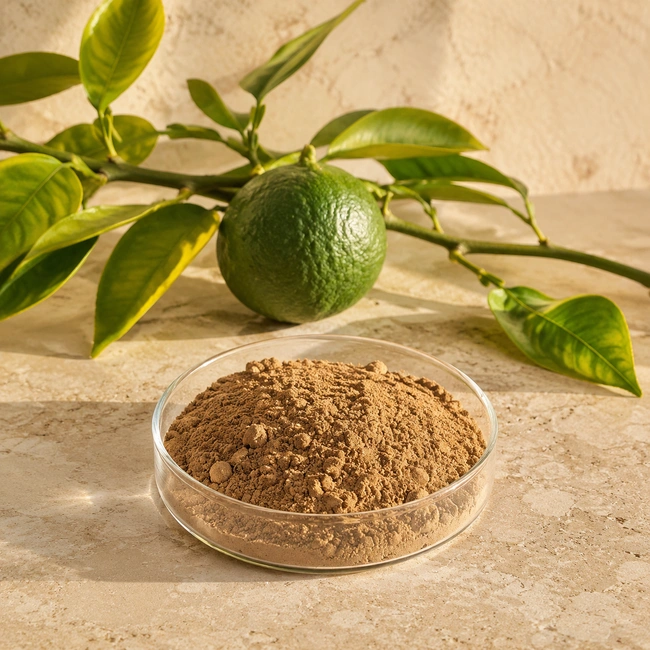
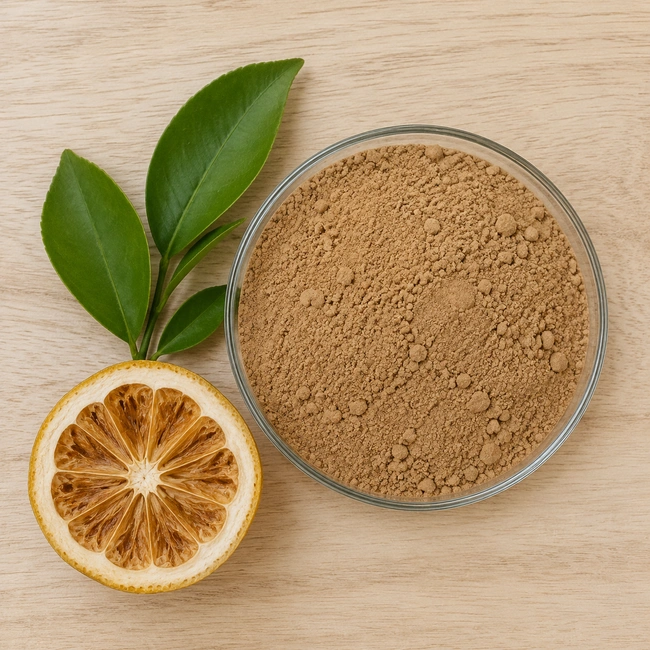
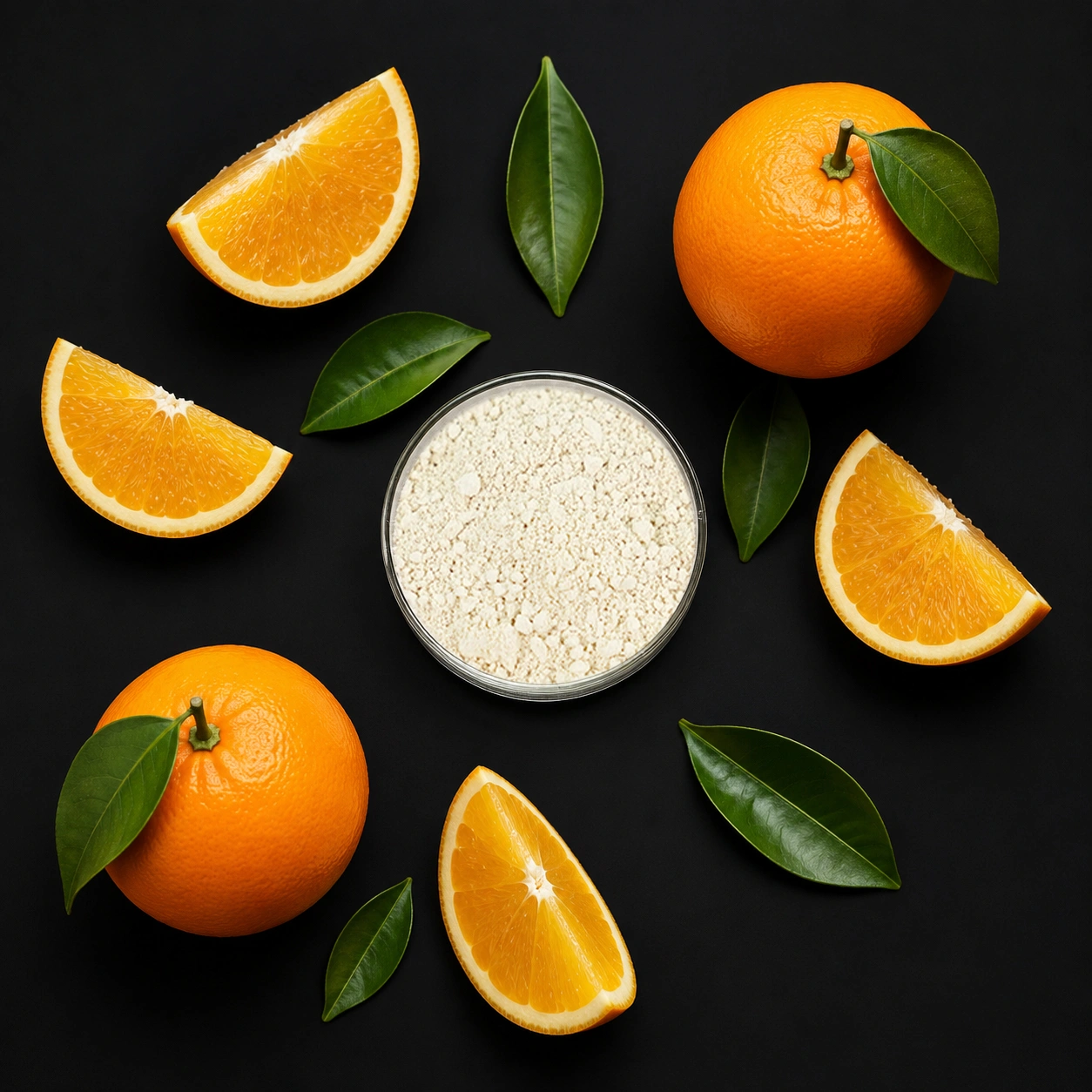
Apigenin is a flavone with the chemical name 4',5,7-trihydroxyflavone. Its CAS number is 520-36-5, its formula is C₁₅H₁₀O₅, and its molecular weight is about 270 g/mol. Plants make it naturally, and it appears in chamomile flowers, parsley, celery, and citrus species. Our apigenin powder comes from Citrus aurantium L., commonly called bitter orange. Source matters because each plant carries a different mix of companion compounds. That mix affects color, allergen review, and the documents a buyer needs. A clear botanical source also helps a brand answer customer questions about origin and write accurate label statements.
Isolated Apigenin Versus Botanical Extracts
Chamomile extract is a mixture. Apigenin is one of several flavonoids in it, usually a small fraction, alongside essential oils and other plant compounds. Isolated apigenin powder works differently. Manufacturers purify it so that one compound makes up most of the material. That gives formulators a defined amount to dose, such as milligrams per capsule or a percentage in a serum. Botanical extracts offer a broader mix of plant compounds, and some brands prefer that for a whole-herb story. Neither choice wins in every case. The right one depends on the product concept, the claim, the dosage design, and the budget. A calm or sleep blend, for example, may pair a defined apigenin dose with other botanicals.
Kang Biotech Apigenin Powder at a Glance
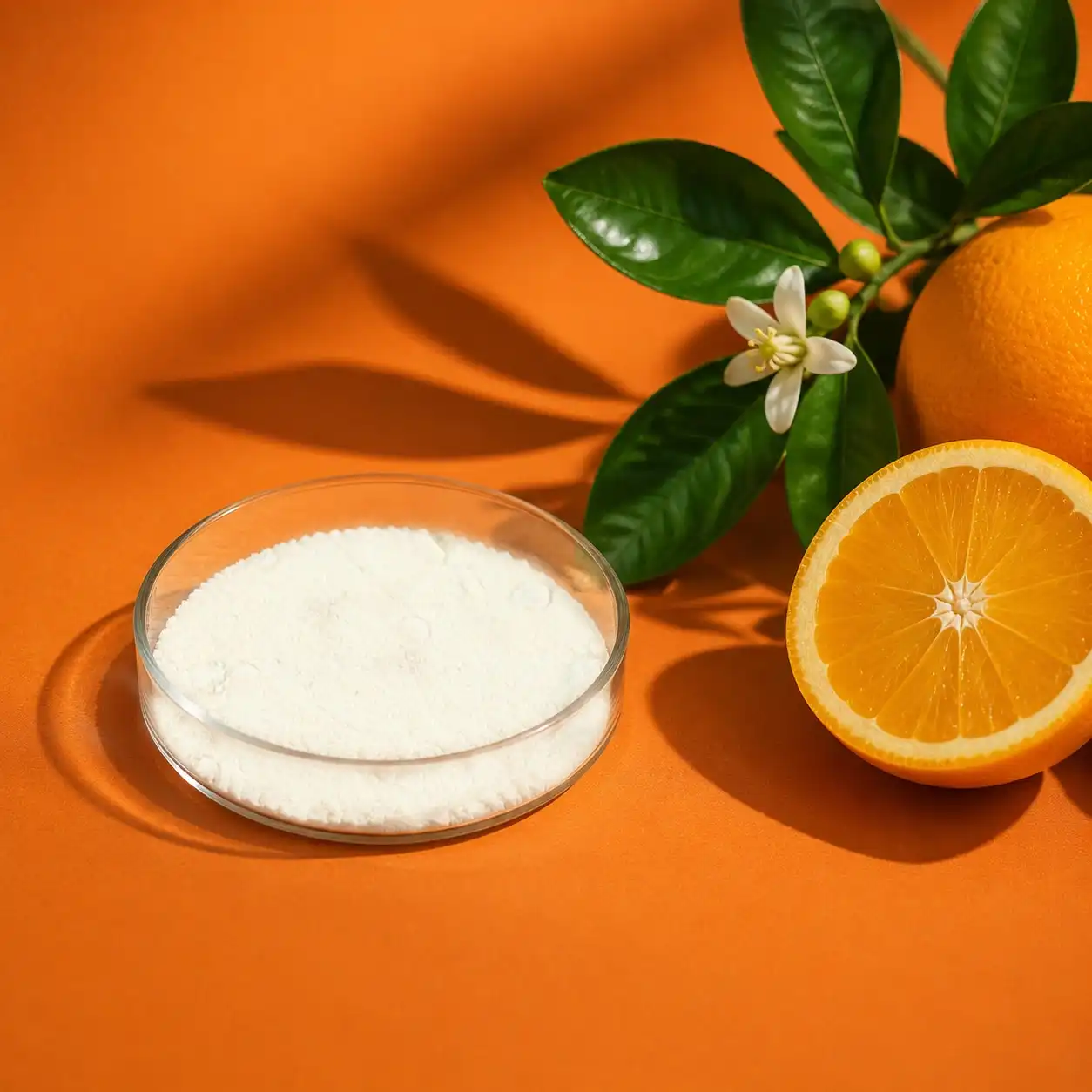
Our apigenin powder is a light yellow to yellow powder made by water extraction or ethanol extraction. The assay is 98% or higher by HPLC, and the grade is food grade. Mesh size is 80-100, loss on drying is 1.0% or less, and heavy metals are below 10 ppm. The melting point is 345-350°C. It dissolves in DMSO and alkaline solutions and is sparingly soluble in hot ethanol. We pack it in 25 kg drums, with a 1 kg minimum order and samples available. We test every batch for assay, heavy metals, and microbiology before release. Sealed storage at room temperature, away from light and moisture, gives a 24-month shelf life. Our bitter orange plantations cover over 20,000,000 m² in Lianyuan, Hunan, which supports steady supply.

What Does Apigenin Do to Your Skin According to Research?
Antioxidant Activity
Skin faces ultraviolet light, pollution, and everyday oxidative stress. Free radicals from these sources can damage lipids, proteins, and DNA in skin cells. A 2019 review in the International Journal of Molecular Sciences describes apigenin as a flavonoid with antioxidant activity. In laboratory settings, it can scavenge free radicals and influence cellular defense systems. That explains why cosmetic and nutricosmetic developers show interest in apigenin powder. Still, a test-tube result does not tell us how much apigenin reaches living skin layers. It also does not show whether a finished cream changes how skin looks. Those answers depend on concentration, delivery system, and product design.
Inflammation-Related Signaling
Redness, sensitivity, and discomfort in skin often involve inflammatory pathways. Reviews of apigenin research report that it can influence signaling molecules linked to inflammation in cell and animal models. A 1997 study in Anticancer Research found that apigenin applied to mouse skin reduced tumor formation after ultraviolet exposure. This showed biological activity in skin tissue in that model. Mouse skin differs from human skin, and that study looked at tumors, not cosmetic appearance. For brands, these findings justify further testing for soothing and after-sun concepts. They do not justify drug-style claims.
What the Evidence Does Not Show?
I want to be straight with you. There are no robust human studies indicating that apigenin reverses ageing, eliminates wrinkles, heals acne or cures a skin problem. In the United States, if a product promises to cure or prevent illness, then the FDA considers it to be a medicine. Cosmetics are supposed to be for washing, beautifying and modifying look. The Modernisation of Cosmetics Regulation Act of 2022 adds imposed responsibilities on cosmetic manufactures such as listing the product and substantiating safety. Under the 1994 DSHEA, structure-function claims may be made for dietary supplements with the requisite disclaimer and notification to the FDA. Every claim should be supported by appropriate testing and legal scrutiny prior to launch.
How Can Apigenin Powder Be Used in Skin and Beauty Products?
Topical Skincare Concepts
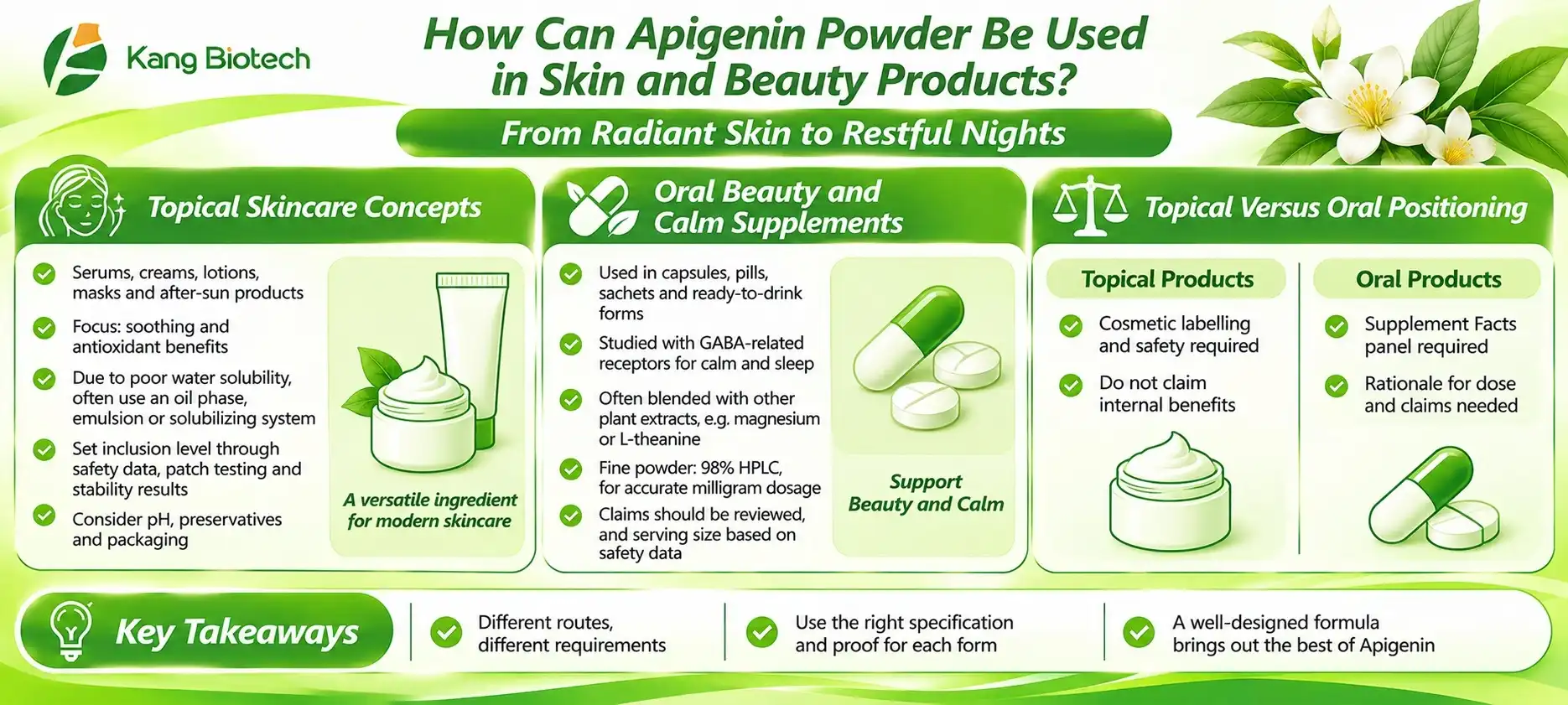
Formulators evaluate apigenin powder for serums, creams, lotions, masks, and after-sun products, mostly around soothing and antioxidant concepts. Our grade is food grade, and cosmetic requirements differ. A brand planning a topical product should confirm the needed specification and documents with our technical team before development starts. Because the ingredient dissolves poorly in water, formulators usually need an oil phase, an emulsion, or a solubilizing system. There is no universal inclusion level. Teams set it through safety data, patch testing, stability results, and the claim they intend to make. Finished-product pH, preservatives, and packaging also affect how the ingredient behaves on the shelf.
Oral Beauty and Calm Supplements
Apigenin powder may be used in capsules, pills, sachets and ready-to-drink forms. Apigenin and GABA-related receptors have been studied in preclinical research and calm and sleep brands are especially interested. Brands typically blend it with other plant extracts, and some add minerals or amino acids such as magnesium or L-theanine. The fine powder is suitable for accurate milligram dosage in the manufacturing of capsules and tablets at 98% HPLC. Claims related to structure and function should be reviewed by claims. A supplement should never claim to relieve sleeplessness or anxiety. Serving size should be based on safety data and product-specific trials, not a one-size-fits-all rule.
Topical Versus Oral Positioning
Topical and oral drugs have different needs. Route of use influences the safety assessment, the logic of dosage, the labelling and the regulatory approach. A cream must be proven for cosmetic labelling and safety. For a pill, Supplement Facts panel, rationale for dose and compliance claims are required. If a brand has both forms, it should have a separate proof file for each form. A face lotion should not provide internal sleep advantages. A medication should not guarantee acne cure. There could also be a difference in particle size. The OEM/ODM additionally may adjust the particle size for certain distribution methods.
Apigenin Powder Solubility, Stability, and Safety Considerations
Solubility and Delivery Systems
Apigenin is not readily soluble in water. We specify that it is soluble in DMSO and in alkaline solutions and sparingly soluble in hot ethanol. This makes it difficult for water-based serums and beverages since the powder might settle out or precipitate. This is overcome via particle-size reduction, emulsification, lipid-based delivery, cyclodextrin complexes and liposomes used by formulators. None of the approaches is technically validated or automatically enhances absorption or clinical outcomes. We can do OEM/ODM changing particle size, such as micronization, for dissolving. When you’re vetting apigenin powder providers, ask for solubility data that includes the solvent, temperature, pH and test technique.
Stability and Storage
The melting point of 345-350°C sits far above standard tableting and heat-sealing temperatures. Light, oxygen, and moisture are the bigger concerns, and flavonoids can degrade under prolonged light exposure. We recommend sealed, light-resistant containers kept at room temperature, away from moisture, which supports a 24-month shelf life. Finished products need their own testing. Preservatives, excipients, pH, and packaging can change how apigenin powder behaves in a formula. Run accelerated and real-time stability studies on the final product, and consider a third-party laboratory for independent results.
Safety, Side Effects, and Interactions
Safety depends on the method, the dosage, the purity, the period of exposure and the person. Possible consequences include moderate stomach pain, allergic reactions and skin irritation or sensitisation. Excipients might cause responses also. In a 1998 research published in Drug Metabolism and Disposition, it was shown that several cytochrome P450 enzymes were inhibited by numerous flavonoids, including apigenin, in lab studies. These enzymes assist to digest various drugs. For that reason, oral product labels should tell anybody who takes prescription medicines, sedatives or blood thinners to consult with a healthcare provider before use. The same recommendation goes for those who are pregnant or breastfeeding.
How to Choose and Buy Apigenin Powder in Bulk
Specifications and COA Review
Decide how you want to use it. Skin care, vitamins, drinks, or research. Then match the grade to it, since food-grade, cosmetic-grade and pharmaceutical-grade labels vary across markets and need official verification. Request a batch specific COA with HPLC test, heavy metals, microbiological limits, moisture and particle size. Include findings for residual solvent and pesticides, when applicable. Any 98% or 99% apigenin powder claim requires an analytical approach behind it to support the claim. High purity alone does not guarantee minimal contaminants, high solubility, or regulatory fit. We provide COAs, Safety Data Sheets, allergy declarations and claims compliance documentation for major markets.
Common Buying Mistakes
Some mistakes are repeated again and again. Buyers see assay as the only measure of quality. Suppose isolated apigenin equals chamomile extract. Choose the lowest price. Without reviewing paperwork. Or create skin claims, the proof cannot support. Later they each cost money. Out-of-spec material equals delays, re-testing and possibly a disastrous launch. Botanical extracts also differ in active concentration and allergen profile, thus changing one for another mid-project might need a complete reformulation. A fair comparison would be to look at the overall cost; testing, paperwork, packing, delivery time, technical support and the difficulty of dealing with uneven batches.
Evaluation Steps, OEM/ODM, and Supply
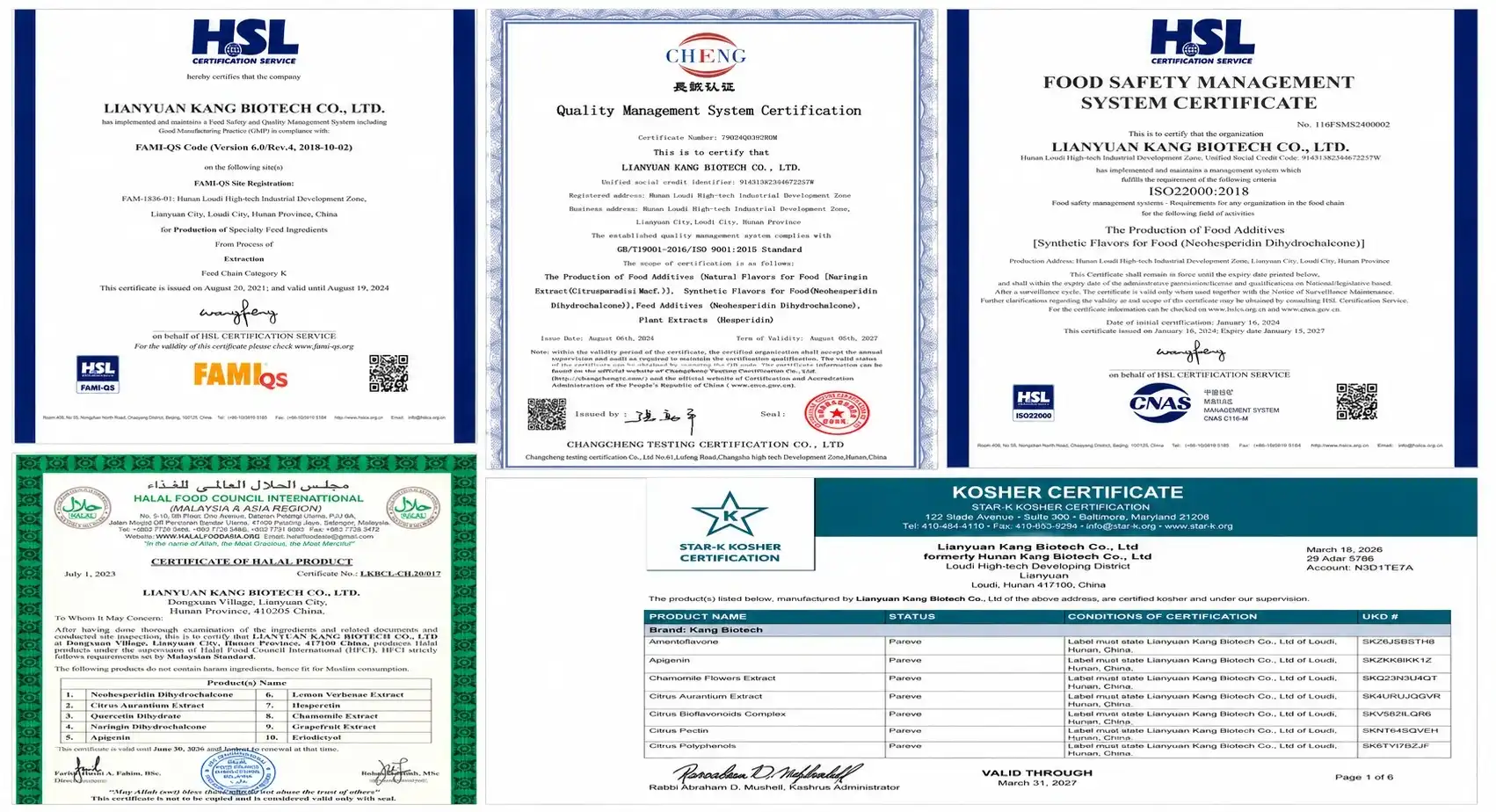
A straightforward method reduces risk. Define the application and target market, define minimum specs and request samples and batch COAs. Then evaluate identification, assay, dispersion and stability and make a trial order before committing to volume. Get the confidentiality conditions in writing before you hand out secret formulae. Kang Biotech makes this procedure easy with a minimum order of 1 kilogram, samples and ready stock. Small orders are sent via rapid courier, while big orders are sent by air or sea in 25kg barrels. Our OEM/ODM services encompass specification adjustments, particle size adjustments, bespoke packaging and labelling, technical documentation for regulatory filings, and formulation consultancy. We are certified to ISO 9001, ISO 22000, HACCP, Halal, Kosher and FAMI-QS, and have clients in over 40 countries and regions.
Conclusion
Apigenin is a plant flavonoid studied for antioxidant and inflammation-related activity, and most skin evidence comes from laboratory and animal work rather than human trials. That limits what brands can claim in the United States, where cosmetic, supplement, and drug rules apply differently. Isolated apigenin powder gives a defined dose compared with botanical extracts. However, limited water solubility, light sensitivity and probable medication interactions need careful design of administration, stability testing and unambiguous labelling. 98% HPLC figure is only one aspect. Source, COA contents, contaminant findings, particle size and batch consistency also determine whether a recipe makes the cut and passes inspection. To accomplish this best, combine technical testing with supplier documentation and make statements supported by proof.
FAQ
1. Can apigenin powder remove wrinkles or treat acne?
No. Lab and animal research demonstrate antioxidant and inflammation-related activities, but human evidence for those outcomes is sparse.
2. Is apigenin powder soluble in water?
No. It dissolves in DMSO and alkaline solutions and sparingly in hot ethanol, so water-based products need a delivery system such as an emulsion or cyclodextrin complex.
3. How does apigenin powder differ from chamomile extract?
Our product is standardized to 98% by HPLC. Chamomile extract contains many plant compounds, with apigenin as a smaller and more variable fraction.
4. Does apigenin interact with medicines?
Laboratory research shows some flavonoids inhibit certain cytochrome P450 enzymes, so labels should advise consulting a healthcare professional when using prescription drugs.
5. What documents and order terms do you offer?
We have COA’s, Safety Data Sheets, allergy declarations and claims compliance documentation. Minimum Order Quantity 1 Kilogram. Sample Available Yes Shelf life is 24 months in sealed condition at room temperature, protected from light and moisture.
Request an Apigenin Powder Sample or Quotation from Kang Biotech
Kang Biotech is a direct manufacturer with over 20 years of citrus extraction expertise, offering 98% HPLC apigenin powder from ready stock. If you need an apigenin powder supplier with a 1 kg minimum order, samples, 25 kg drums, and OEM/ODM support, email sales02@kangbiotech.com with your application and volume. Visit cnkangbiotech.com for more details, and our team will reply with specifications, documents, and a quotation.
References
1. International Journal of Molecular Sciences, 2019: "The Therapeutic Potential of Apigenin"
2. Pharmaceutical Research, 2010: "Apigenin: A Promising Molecule for Cancer Prevention"
3. Anticancer Research, 1997: "Inhibition of Ultraviolet Light Induced Skin Carcinogenesis in SKH-1 Mice by Apigenin, a Plant Flavonoid"
4. Phytotherapy Research, 2006: "A Review of the Bioactivity and Potential Health Benefits of Chamomile Tea (Matricaria recutita L.)"
5. Advances in Nutrition, 2017: "Flavones: Food Sources, Bioavailability, Metabolism, and Bioactivity"
6. Drug Metabolism and Disposition, 1998: "Comparative Inhibition of Human Cytochromes P450 1A1 and 1A2 by Flavonoids"

Send Inquiry
Related Industry Knowledge
- What Does Apigenin Do to Your Skin?
- Naringin And Naringenin: What Are Antioxidant Ingredients?
- Benefits of Naringin Supplement for Health and Wellness
- How Glucosyl Hesperidin Fits Modern Skincare Formulas
- Why Is Polymethoxy Flavonoids Powder Used in Wellness Formulas?
- Tap Into the 7 Amazing Health-Saving Properties of Apigenin
- What is Neohesperidin Dihydrochalcone?
- Where Does Hesperetin Powder Fit in Nutraceutical Innovation?
- NDHC: an updated review on a naturally derived sweetener and flavor potentiator
- How to Use Neohesperidin Dihydrochalcone Powder in Beverages for a Low-Calorie Boost?