
What Is Naringin Dihydrochalcone Powder Used For?
November 18, 2026
Naringin dihydrochalcone powder is used mainly as a high-intensity sweetener and a flavor modifier. They are used in tiny doses by formulators in sugar-reduced drinks, dairy, confectionery and oral care products. They also employ naringin dihydrochalcone to mask any bitterness, metallic notes or medicinal notes from plant proteins, botanical extracts and active substances. At 500 to 700 times sweeter than sucrose, a few parts per million may alter the flavour of a product. This is a useful option if you want to manage both the sugar level and the level of bitterness in the same recipe. This handbook discusses applications, sensory behaviour, comparisons, purchase stages and points of safety.

Introduction: What Is Naringin Dihydrochalcone Powder?
Definition and Origin of Naringin Dihydrochalcone
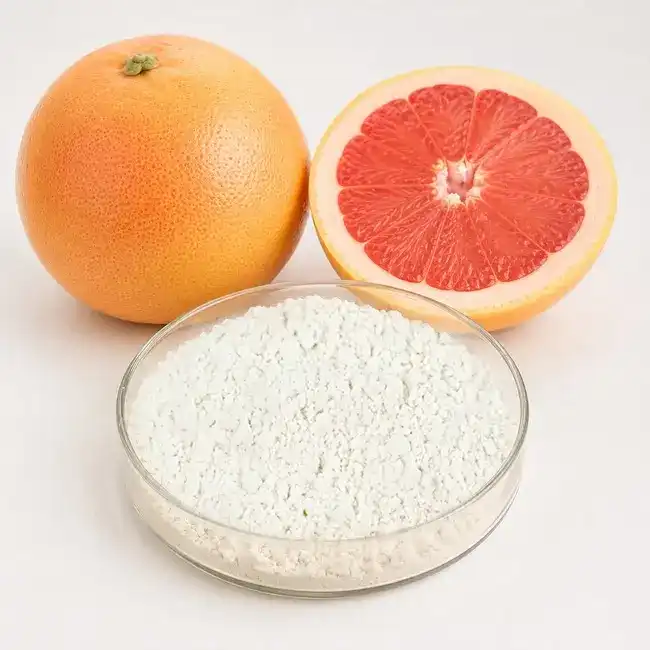
Naringin is a bitter flavonoid found in grapefruit and other citrus fruits. When it is treated with a strong base and then catalytically hydrogenated, it becomes a dihydrochalcone that tastes sweet instead of bitter. USDA researchers studied this chemistry in the 1960s while looking for ways to reduce bitterness in citrus juice. Our naringin dihydrochalcone carries CAS No. 18916-17-1 and comes as a white, food-grade powder at 98% HPLC purity. Do not confuse it with neohesperidin dihydrochalcone, which has CAS No. 20702-77-6.
Why Global Manufacturers and Formulators Use Naringin Dihydrochalcone
Flavor solution teams, beverage brands, supplement makers, and oral care developers choose naringin dihydrochalcone for three reasons. The dose is tiny, so sugar and calories drop. It softens bitterness that flavors alone struggle to cover. And it comes from citrus. Suitability, dosage, and legal status still vary by market and product category, so each project needs its own checks. We make the powder by water extraction or ethanol extraction.
Kang Biotech at a Glance
Kang Biotech was founded in 2011. We manage more than 20,000,000 m² of bitter orange plantations in Lianyuan, Hunan Province, and run a 33,000 m² plant with nine production lines. Our technical team has over 20 years of citrus extraction experience, and a joint research center with the Hunan Institute of Agricultural Product Processing and Quality Safety supports our development work. We supply customers in more than 40 countries.

What Is Naringin Dihydrochalcone Powder Used For?
High-Intensity Sweetening in Reduced-Sugar Products
Sugar reduction is the most common use. Naringin dihydrochalcone is about 500 to 700 times sweeter than sucrose, so typical levels are 10 to 20 mg per kg in dairy and 25 to 55 mg per kg in sugar-free beverages. Those small doses add almost no calories and keep formulation cost low. The sweetness builds slowly and lingers, with a mild licorice-like note, so we suggest testing it next to stevia or another sweetener. It also fits jellies, jams, fruit preparations, confectionery, chewing gum, and frozen desserts.
Flavor Masking and Taste Modification
Many flavor solution teams start with bitterness masking. Naringin dihydrochalcone is thought to work by competitively inhibiting bitter taste receptors, which helps with off-notes from plant proteins, botanical extracts, vitamins, minerals, and amino acids. In functional drinks, 10 to 30 ppm can soften the metallic aftertaste of steviol glycosides. Results depend on the bitter source, pH, and flavor system, so run bench trials at several doses. Too high a dose adds lingering sweetness the product may not need.
Food, Beverage, Nutraceutical, Pharmaceutical, and Oral Care Uses
Beyond drinks, naringin dihydrochalcone suits low-sugar ice cream, yogurt, and milk beverages, and it resists freeze-thaw cycles. Pharmaceutical developers add it to liquid oral solutions and chewable tablets to reduce bitterness and support patient compliance. It also sweetens toothpaste and mouthwash. In animal nutrition, it improves palatability in piglet and poultry diets and tolerates pelleting heat. In citrus-style drinks, it can soften bitterness and sourness in one step. Confirm legal status for each category and destination market.
How Does Naringin Dihydrochalcone Taste and Perform?
Naringin Dihydrochalcone Taste Profile and Sweetness Intensity
Naringin dihydrochalcone starts sweet more slowly than sucrose and lasts longer, with a mild licorice-like note. Its strength of 500 to 700 times sucrose means dosing is measured in ppm, not percent. In our assessment, it has a shorter onset and a cleaner finish than neohesperidin dihydrochalcone, which leaves a menthol-like note, so it suits neutral sweetness targets. The same dose tastes different in a dairy base, a carbonated drink, and a protein shake. Run sensory panels at three or more dose levels.
Solubility and Dispersion Considerations
The naringin dihydrochalcone powder dissolves well in hot water and aqueous ethanol. We control particle size at 80 to 100 mesh, which speeds dissolution in industrial mixing systems. For cold-process drinks, pre-dissolve it in warm water or a little ethanol, then add the solution to the batch. For dry blends, pre-mix it with a carrier such as maltodextrin so a microdose spreads evenly. Even dispersion matters because a few parts per million leave little room for error.
Stability During Processing and Storage
The ingredient holds up under pasteurization and UHT, and it works at temperatures up to 160°C. Its melting point is 156–158°C. That supports baking, pelleting, and hot-fill processes. Light, oxygen, moisture, and pH can still shift performance, so we advise accelerated and real-time stability studies in the finished matrix. The powder is slightly hygroscopic. Store it sealed, cool, and dark, below 25°C and 60% humidity. Shelf life is 24 months under those conditions.
Naringin Dihydrochalcone vs. Other Sweeteners and Flavor Modifiers

Naringin Dihydrochalcone vs. Naringin
Naringin and naringin dihydrochalcone share a citrus origin but taste opposite. Naringin is the bitter flavonoid in grapefruit peel and juice. Hydrogenation converts it into the sweet dihydrochalcone. In a formula, naringin adds bitterness, while naringin dihydrochalcone helps mask it. Make sure your specification names the correct compound by CAS No. 18916-17-1 and the HPLC assay, because the two ingredients sit in different sensory and regulatory categories.
Naringin Dihydrochalcone vs. Neohesperidin Dihydrochalcone
Neohesperidin dihydrochalcone is a structural cousin, not the same molecule. It is far sweeter, often cited at 1,500 to 1,800 times sucrose, while naringin dihydrochalcone sits at 500 to 700 times. The lower intensity makes small dose changes easier to control. Regulatory records differ too. In the EU, neohesperidin dihydrochalcone carries additive number E 959, and FEMA 3811 refers to it, not to naringin dihydrochalcone. Confirm limits and listings for each compound with your regulatory advisor.
Naringin Dihydrochalcone vs. Stevia, Sucralose, Aspartame, and Clean-Label Fit
Stevia can leave a bitter or metallic aftertaste. Sucralose and aspartame start faster, and they differ in heat and pH stability. Naringin dihydrochalcone starts slower, lingers longer, and softens off-notes, which is why blends are common. A small amount can round out steviol glycosides. Compare onset, aftertaste, solubility, stability, labeling, and cost in use in your own base rather than relying on one sweetness ratio. For clean-label claims, verify origin, process, and market-specific definitions, because hydrogenation is part of the route.
How to Select and Verify Food-Grade Naringin Dihydrochalcone Powder
Define the Application and Regulatory Market
Start with the end product and the country of sale. A US beverage, an EU supplement, and a pet food follow different rules, and use limits differ. Write down your target dose, pH, process temperature, and claim before you request quotes. Then ask the supplier for regulatory documents that match your market, including its FEMA and GRAS position for naringin dihydrochalcone. If your customers need Halal, Kosher, or FAMI-QS, say so in the first request.
Evaluate Specifications and Documentation
Request a current Certificate of Analysis, specification sheet, and Safety Data Sheet. Our food-grade powder is 98% HPLC, white to off-white, with 80–100 mesh particles, lead below 1.0 ppm by ICP-MS, and no Salmonella or E. coli. We also test arsenic, mercury, cadmium, and yeast and mold. Because the compound comes from hydrogenation, ask any supplier for residual solvent data on each lot. We also provide non-GMO, not irradiated, and non-BSE statements, plus Halal and Kosher certificates.
Verify Manufacturer, Certifications, and Packaging
Verify that the supplier has ownership of the facility. As a direct manufacturer, our systems are ISO 9001, ISO 22000, HACCP, Halal, Kosher and FAMI-QS certified. Enquire about certificate scope and expiration dates. Check change control and batch release methods. Standard packaging is 25 kg per fibre drum lined with polyethylene. The mildly hygroscopic powder is protected by a sealed liner for air or sea transport. OEM or ODM service includes bespoke packaging and labelling.

How to Buy Naringin Dihydrochalcone in Bulk
Compare Prices and Ask Key Procurement Questions
Price per kilogram tells only part of the story. Compare quotes at the same purity, package, Incoterm, destination, payment terms, and test requirements. Then calculate cost per effective dose. At 10 to 20 mg per kg in dairy or 25 to 55 mg per kg in sugar-free beverages, a high-intensity ingredient costs little per serving. Ask each supplier whether it makes the product and how it secures raw material. We manage our own citrus plantations, so raw-material planning stays inside our chain.
Sample Orders and Pilot Formulation
Try a sample before you buy. Samples are available and we have a minimum order of 1kg. Now work in 4 stages. First, choose whether you want to reduce the sweetness, cover the bitterness, or both. Second, prepare bench recipes at multiple dosages, with and without a second sweetener. Third, test mixing, heating, filling and storage conditions. Fourth, perform a pilot batch to test the accuracy of the dosing and uniformity of the batch before you accept a specification.
MOQ, Packaging, and Lead-Time Planning
We have adequate stock on hand, small purchases are sent fast by FedEx, and bigger orders are shipped air or sea freight. Bulk packing: 25 kilogram per drum. Confirm lead time on your volume, port and Incoterm. For extended programs, describe how modifications will be communicated, and the specification agreed upon. We provide OEM and ODM service for bespoke specs, purity, packaging and labelling.
Safety, Dosage, and Regulatory Considerations
Is Naringin Dihydrochalcone Safe?
Safety depends on the market, the product category and the exposure amount. Upon request, we may give evidence of GRAS and FEMA status. FEMA 3811 is neohesperidin dihydrochalcone . Buyers should consult with a regulatory authority to ensure the precise listing for their product . If your consumers comprise sensitive categories, get toxicological and cross-reactivity data. Review supplier purity data, contaminant findings and allergy information prior to clearance.
Naringin Dihydrochalcone Dosage and Use Level
There isn't one correct dosage for each product. From our research, typical beginning points are 10 to 30 ppm in liquids for masking, 25 to 55 mg per kg in sugar free beverages, 10 to 20 mg per kg in dairy and 20 to 50 ppm in solid matrices. The ultimate level should be decided by sensory and analytical tests. Naringin dihydrochalcone is not automatically included in the limits for E 959. When scaling, verify the current legislation in each target nation.
Potential Side Effects and Risk Management
Published side-effect data for naringin dihydrochalcone at food use levels are limited, so cautious review is sensible. Main risks come from overdosing, poor dispersion, and unverified suppliers. Keep batch traceability, retain samples, and log complaints. Ask for allergen statements and heavy metal results. If your product serves patients on medication, request interaction data and have your regulatory team approve claims and labeling.
Conclusion
Naringin dihydrochalcone is a citrus-derived sweetener and flavour modifier produced by the conversion of bitter naringin to a sweet dihydrochalcone. Its major applications are sugar reduction, 500 to 700 times sweeter than sucrose, and bitterness masking in beverages, dairy, vitamins, dental care, pharma liquids and feed. Its gradual lingering sweetness and heat stability to 160°C define its use by developers - often at levels in the ppm range and commonly in blends. It varies in taste and sweetness level and regulatory record from naringin and from neohesperidin dihydrochalcone. For the sound selection, use the CAS number, the requirements, the batch documents, sample trials, and the stability data of the completed product.
FAQ
1. What is naringin dihydrochalcone powder mainly used for?
It serves as a high-intensity sweetener and bitterness-masking flavor modifier in beverages, dairy, confectionery, oral care, and pharmaceutical products.
2. Is naringin dihydrochalcone the same as naringin?
No. Naringin is bitter. Naringin dihydrochalcone is its sweet, hydrogenated derivative.
3. How sweet is naringin dihydrochalcone?
It is about 500 to 700 times sweeter than sucrose, with slow onset and lingering sweetness.
4. Is naringin dihydrochalcone soluble in water?
It dissolves well in hot water and aqueous ethanol. Pre-dissolve it for cold-process batches.
5. Can naringin dihydrochalcone be used in beverages?
Yes. Typical levels are 10 to 30 ppm for masking and 25 to 55 mg per kg in sugar-free drinks.
6. How should I choose a naringin dihydrochalcone supplier?
Review plant ownership, certifications, batch COAs and sample performance in your own formula.
7. Can I buy naringin dihydrochalcone powder directly from a manufacturer?
Yes. We sell direct, with a 1 kg MOQ, samples, 25 kg drums, and OEM or ODM options.
Request a Naringin Dihydrochalcone Sample or Bulk Quotation
Kang Biotech is a direct naringin dihydrochalcone manufacturer with 98% HPLC food-grade powder in stock, a 1 kg MOQ, and samples ready for lab evaluation. Send your application, country of destination, volume, and document needs to sales02@kangbiotech.com, and we will reply with specifications, lead time, and a quotation. We support OEM and ODM packaging and ship by FedEx, air, or sea. Visit cnkangbiotech.com for more details.
References
1. Journal of Agricultural and Food Chemistry (1969): Horowitz, R. M., and Gentili, B. "Taste and Structure in Phenolic Glycosides."
2. Journal of the Science of Food and Agriculture (2000): Tomás-Barberán, F. A., and Clifford, M. N. "Flavanones, Chalcones and Dihydrochalcones: Nature, Occurrence and Dietary Burden."
3. Chemosensory Perception (2008): Ley, J. P. "Masking Bitter Taste by Molecules."
4. Food Technology (2005): Smith, R. L., et al. "GRAS Flavoring Substances 22."
5. Official Journal of the European Union (2008): Regulation (EC) No 1333/2008 on Food Additives.
6. Federal Register (2016): U.S. Food and Drug Administration, "Substances Generally Recognized as Safe," Final Rule.

Send Inquiry
Related Industry Knowledge
- Naringin And Naringenin: What Are Antioxidant Ingredients?
- Naringin Dihydrochalcone vs Neohesperidin DC: Key Differences
- Why Is Polymethoxy Flavonoids Powder Used in Wellness Formulas?
- What Is Neohesperidin Dihydrochalcone Used For as a Sweetener?
- Neohesperidin Powder vs Hesperidin: Key Differences Explained
- Exploring Antioxidant Applications of Polymethoxy Flavonoids Powder
- 4 Benefits of Naringin For Your Health
- NHDC Sweetener Guide: How Neohesperidin Dihydrochalcone Is Changing Low-Calorie Foods
- Nobiletin Benefits for Brain Health and Metabolism
- 3 Health Benefits of Horny Goat Weed