
How to Choose a Polymethoxy Flavonoids Powder Manufacturer
November 4, 2026
One of the most crucial sourcing choices a nutraceutical or longevity brand can make is choosing the correct polymethoxy flavonoids powder producer. Procurement teams are feeling the heat to source ingredients that deliver on label promises and regulatory scrutiny, as PMF formulations gain appeal with consumers in the metabolic health, anti-aging and anti-inflammatory categories. In this article, we'll take you through what differentiates a reputable supplier of citrus PMF from a dubious one—what quality standards to watch out for, how to source, and what supplier assessment factors matter most to B2B customers in North America and elsewhere.
Understanding Polymethoxy Flavonoids Powder and Its Market
What PMFs Actually Are
The flavone backbone of polymethoxy flavonoids powder, a concentrated citrus extract, has numerous methoxyl groups attached. The main markers that are active are nobiletin and tangeretin. They come from the apex of Citrus sinensis and Citrus reticulata. These methylated compounds are lipophilic, while glycosylated flavonoids like Hesperidin are not. In other words, they can go through cell walls without being moved. The drug is bioavailable in smaller amounts because of this change in structure.
Where PMFs Are Applied
Polymethoxy flavonoids powder is needed for functional food and drink lines, neuroprotective nutraceuticals, sports nutrition items that activate AMPK pathways, and cholesterol-lowering vitamins. There is a broad-spectrum PMF profile that is loved by longevity brands. It is made up of Nobiletin, Tangeretin, and Sinensetin working together. This is because this multi-compound action can't be done by a single-molecule ingredient. In experimental models, PMFs have been shown to change the expression of genes that make lipids and improve metabolic function.


Key Market Challenges for Buyers
The thing that worries buying teams the most about polymethoxy flavonoids powder is that it can be different from batch to batch. If the company that makes the medicine doesn't have good controls for HPLC fingerprinting, two batches that have the same label claims could have very different amounts of Nobiletin to Tangeretin. In the EU and the US, PMFs can legally be sold as food ingredients, but they do not have a GRAS designation on their own. This is also something to keep in mind. Buyers should make sure that the paperwork their supplier gives them is in line with FDA rules for new foods and EU rules for dietary supplements before they sign a supply agreement.
Core Criteria for Selecting a PMF Manufacturer
Certifications That Actually Matter
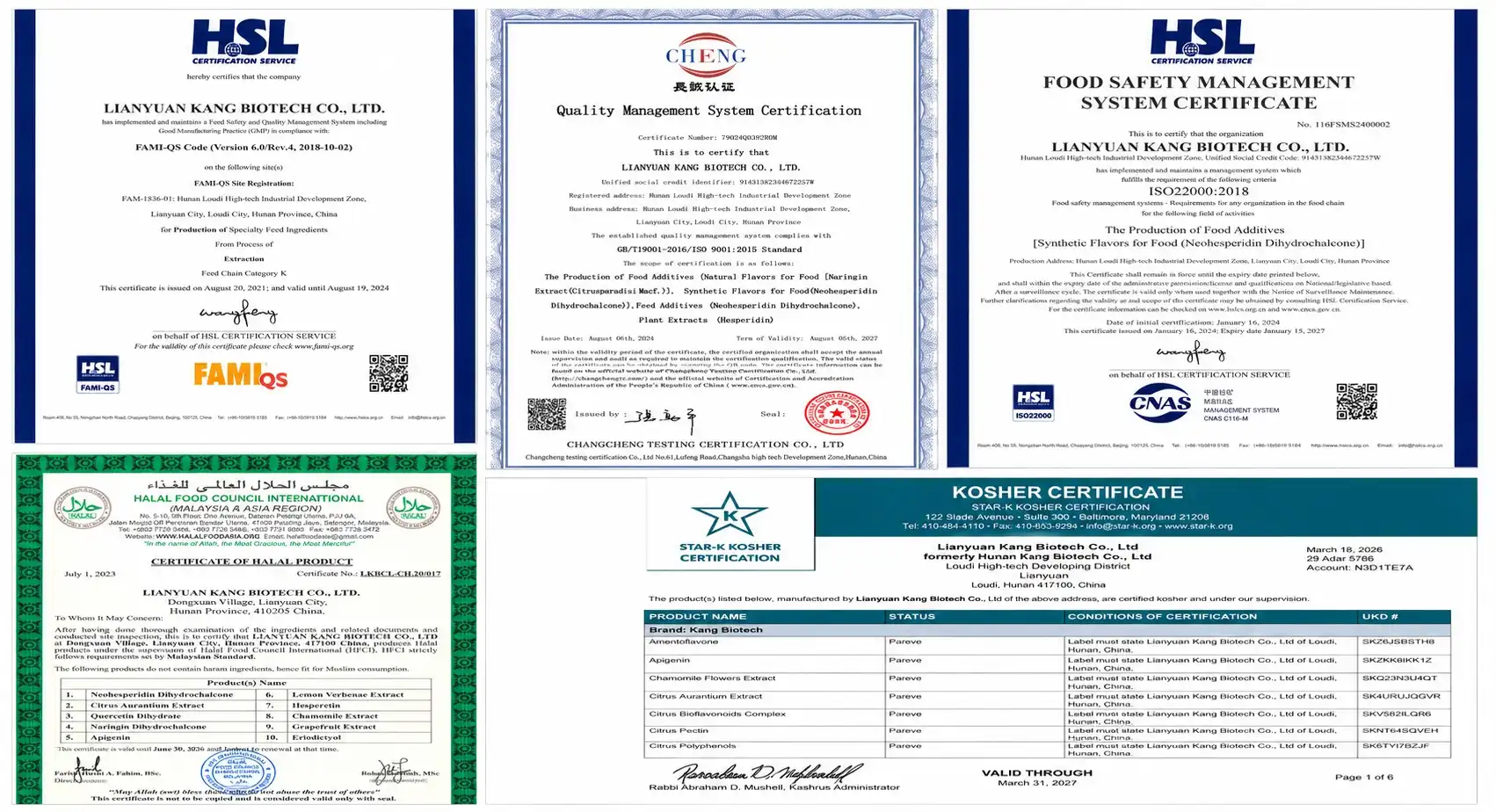
Any real company that makes polymethoxy flavonoids powder should have GMP approval at the very least. ISO 9001 (quality management) and ISO 22000 (food safety management) also show that production systems are checked regularly and not just by the person who is in charge. Getting Halal, Kosher, or HACCP certified can help you sell your goods in more places and reach more customers. People who want to buy supplements for sale in North America should also look for FDA facility registration and paperwork that backs up the rules for supplement labels.
Purity Standards and Analytical Verification
A good PMF extract should have at least 80% total polymethoxylated flavones, which can be checked using HPLC. The teams that are buying things should demand a Certificate of Analysis that shows the precise amounts of each marker, not just the sum. One test number is not as good of a quality signal as an HPLC-DAD fingerprinting that shows clear bands for Nobiletin, Tangeretin, and Sinensetin. Carbon-14 date and GC-MS residue solvent analysis are two other ways to tell the difference between real PMF powder made from citrus fruits and material that has been spiked with chemicals.
Supply Chain Transparency and Capacity
A company with its own supply of raw materials is less likely to be influenced by fluctuations in the market than one that receives its resources from a variety of spot-market dealers. It is feasible to trace the product from the farm to the shop shelf with the direct management of plantations. This implies that the bitter orange trees are owned by the firm that owns the extraction plant and takes care of them. Your skills in making things should also be appropriate to the task you expect to accomplish. For instance, a facility with nine or more specialised extraction lines may accept requests for 1 kilogram samples without disturbing the scheduling of big batches.

Comparing Manufacturers and Suppliers: What Sets the Best Apart
Reputation, Documentation, and Third-Party Validation
Most popular polymethoxy flavonoids powder vendors support their quality claims by reports from other laboratories, not only their own COAs. Ask the firm whether their quality records have been reviewed by professional dietitians or recipe scientists and if they have been verified by more than one consumer. Often times when businesses attend Supply Side West or upload application data on NIH ODS compliant sites, they add additional documentation.
See these genuine provider differences before you choose one:
- Is the COA showing separate ratios of Nobiletin, Tangeretin and Sinensetin or just a cumulative total? HPLC fingerprint completeness: If a provider only says "Nobiletin & Tangeretin" but suggests they are receiving a comprehensive wide spectrum profile you should request a complete HPTLC multi-flavonoid fingerprint before proceeding.
- Disclosure of extraction method: Water extraction and ethanol extraction have differing solubility and purity characteristics. Find out what process your batch will be run on and check it works with your downstream formulation (e.g., lipid-based softgels vs aqueous drinks).
- OEM/ODM Capabilities. If your longevity brand demands a particular Nobiletin-to-Tangeretin ratio or a specific particle size for encapsulation efficiency, then make sure the manufacturer has the technical staff and equipment to produce that specification and not just the standard 80% HPLC SKU.
This is where you can separate the manufacturers who really own the process and the ones that merely utilise certificate style to fill in the blanks. You want to purchase from a provider that is prepared to offer you thorough batch data and chat about particular formulas; it's much safer. Some vendors will send you pricing sheets solely.
OEM Models and Pricing Structure
The pricing of Polymethoxy flavonoids powder is quite variable according to the manufacturers and dealers. This is particularly the case with DDP terms on delivery inside North America. The cost per kg is cheaper when kept in conventional 25 kg fibre drums with two food grade plastic closures than when stored in smaller units. Consider the goods kind while comparing quotations. For example, FedEx is ideal for samples smaller than 25 kg, air freight is better for critical business shipments and sea freight is better for huge orders that can be delivered affordably. The landing cost may make a huge impact in the ultimate price .
Navigating the Procurement Process for Polymethoxy Flavonoids Powder
Step 1: Sample Request and Lab Verification
Most often, 7 to 14 days are needed from sample submission to decision making on PMF components. Ask for it to check the supplier's COA with HPLC of at least 100 grams of polymethoxy flavonoids powder. Check that the moisture content is 5%, and if your supplement is regulated, complete your own heavy metal panel (USP 233> specifies to test for Pb, As, Cd, and Hg).
Step 2: Qualification Audit and Documentation Review
Before you allow a polymethoxy flavonoids powder provider utilise it in manufacturing you should check out the whole quality dossier. They should include a list of their GMP and ISO certifications, allergy declaration, a pesticide residue report with data for over 400 substances that fulfil the criteria of the EU and USDA, and microbiological release data according to AOAC recommendations. A formulation specialist or a licensed nutritionist advisor should be asking for HPTLC multi-flavonoid mapping data now, not after the order has been placed.
Step 3: Commercial Order and Logistics Coordination
Most of the time, it takes 30 to 90 days to make PMFs that are made to order. Standard HPLC grades of 80% that are in stock and can be sent out within days. Plan your launch around these times to avoid having to wait for things to be ready. Make sure that the order comes with all the export paperwork, such as full lists of ingredients and test results from a third party, so that it can get through US customs.
Case Study Snapshot: Applying These Criteria
A North American company that makes a vitamin that helps people live longer picked three possible suppliers of polymethoxy flavonoids powder after SupplySide West. Full pesticide screening data, a carbon-14 origin verification report, and HPLC-DAD fingerprints that showed the amounts of Nobiletin and Tangeretin were given by the chosen seller. Based on the registered dietitian for the brand, the multi-flavonoid profile matched the research that the label said it was based on. Within 10 days, the manufacturer sent a 1 kg sample, passed a remote audit, and within 45 days, sent the first 200 kg commercial batch via air freight. This was in line with the brand's launch window and made sure there were no inventory gaps.
Conclusion
Selecting the proper polymethoxy flavonoids powder manufacturer is more than just getting a pretty pricing. The actual value for nutraceutical brands is in having a constant marker content, accurate analytical data, traceability of source and a supply chain that can support both product development and commercial manufacturing. Buyers are advised to check HPLC findings, certificates, batch paperwork, sample quality, customisation possibilities and delivery capacity before making a bulk purchase. The manufacturer that can give clear answers and thorough documentation is far better positioned to ensure long-term product stability and market compliance. By assessing suppliers on these real-world metrics instead of only on price quotes, companies may eliminate sourcing risks and create a more robust ingredient supply for their next PMF formulation.
FAQ
1.What certifications should a PMF manufacturer hold?
At minimum, look for GMP, ISO 9001, and ISO 22000. Halal and Kosher certifications matter if you serve multi-faith markets. FDA facility registration is important for US market compliance.
2.How are PMFs different from standard citrus flavonoids?
Standard citrus flavonoids like Hesperidin are glycosylated and require active transport for absorption. PMFs carry methoxyl groups that make them lipophilic, allowing passive diffusion across cell membranes and higher systemic bioavailability.
3.Can I order a sample before committing to bulk?
Yes. Reputable polymethoxy flavonoids powder suppliers offer samples starting at 1 kg, shipped via FedEx. This allows your lab team to verify the COA, run HPLC confirmation, and assess formulation fit before placing a production order.
4.What is the shelf life of PMF powder?
With proper storage in sealed, cool, dark conditions, polymethoxy flavonoids powder maintains active marker integrity for 24 months, as confirmed by stability testing.
5.Is PMF powder compliant for US dietary supplement labeling?
PMFs are lawfully marketed as food and supplement ingredients in the US. They do not hold a standalone GRAS designation, but are permissible under existing dietary supplement frameworks. Always confirm current regulatory status with your compliance counsel.
Request Your PMF Sample from Kang Biotech
At the very least, look for GMP, ISO 9001, and ISO 22000 for polymethoxy flavonoids powder. Getting Halal and Kosher licenses is important if you want to sell to people of different faiths. The FDA needs to know about your location in order for you to follow the rules for the US market.Send us an email at sales02@kangbiotech.com or go to cnkangbiotech.com to get a sample or bulk price.
References
1. Gosslau, A., & Chen, K.Y. (2004). Nutraceuticals, apoptosis, and disease prevention. Nutrition, 20(1), 95–102.
2. Manthey, J.A., & Guthrie, N. (2002). Antiproliferative activities of citrus flavonoids against six human cancer cell lines. Journal of Agricultural and Food Chemistry, 50(21), 5837–5843.
3. Mulvihill, E.E., & Huff, M.W. (2010). Antiatherogenic properties of flavonoids: Implications for cardiovascular disease. Canadian Journal of Cardiology, 26(Suppl A), 17A–21A.
4. Huang, Y., & Cai, J. (2019). Nobiletin and tangeretin: Natural polymethoxylated flavones with multi-target metabolic effects. Food & Function, 10(8), 4494–4510.
5. Uckoo, R.M., Jayaprakasha, G.K., & Patil, B.S. (2011). Rapid simultaneous determination of amines and organic acids in citrus using HPLC. Talanta, 83(3), 948–954.
6. Pan, M.H., Lai, C.S., & Ho, C.T. (2010). Anti-inflammatory activity of natural dietary flavonoids. Food & Function, 1(1), 15–31.

Send Inquiry
Related Industry Knowledge
- Glucosyl Hesperidin: Rethinking Hesperidin in Drinks
- Where Does Hesperetin Powder Fit in Nutraceutical Innovation?
- Naringin Dihydrochalcone Food Grade: What Buyers Should Know
- What Are the Benefits of Naringin?
- NHDC Sweetener Guide: How Neohesperidin Dihydrochalcone Is Changing Low-Calorie Foods
- Naringenin Powder vs Naringin: Key Differences Explained
- Nobiletin Benefits for Brain Health and Metabolism
- How to Use Neohesperidin Dihydrochalcone Powder in Beverages for a Low-Calorie Boost?
- What Is Naringenin Powder and How Is It Used?
- Hesperidin: A Citrus Treasure with a Rich History