
Glucosyl Hesperidin as an Antioxidant: What Research Shows
November 6, 2026
Glucosyl hesperidin has been shown to function as an antioxidant in laboratory tests. The study found that hesperidin and its related compounds can get rid of free radicals and change signs of oxidative stress in both cell and animal models. Kang Biotech's α-glucosyl hesperidin powder has an ORAC value of about 12,000 µmol TE/g. It is not easy for native hesperidin to mix with water, but glucosyl hesperidin can. So it's easier to put in drinks, supplements, and skin care items. Still, lab results don't show what will happen to people's health. I'll explain what the numbers mean, how the powder works in recipes, and what you should check before you buy below.
What Is Glucosyl Hesperidin and How Is It Made?
A Citrus Flavonoid with a Sugar Attached
Flavonone glycosides like hesperidin are mostly found in the peel and membranes of citrus fruits. The name for a changed form of it is glucosyl hesperidin. There are about 772.7 g of it per mole, and its molecular formula is C34H44O20. It doesn't mix well with water at about 0.01 g/100 mL, so it tends to settle in serums and cloud drinks. When you add a glucose unit, that changes. That stuff we use for food has the CAS number 161713-86-6 and comes from Citrus sinensis L. It's important to check that the identity and assay data on the certificate of analysis meet your needs since each supplier has their own rules.
Enzymatic Glycosylation of Hesperidin and Dextrin
The process of making α-glucosyl hesperidin is called enzymatic glycosylation. A special helper called an enzyme moves the glucose units from dextrin to hesperidin. The mix is then dried to make a powder. The finished powder breaks down at room temperature at a rate of over 50 g/100 mL, which is around 5,000 times faster than the ingredient. It has been found that the longer sugar chain also makes enzymes work more slowly in the digestive tract. This makes it easier for the body to absorb. In water, hesperidin that hasn't been broken down can settle, so we check each batch for any hesperidin that is still there. It's easiest to see even a small amount of sediment in clear drinks and serums, so this check is very important.
Product Specifications at a Glance
The α-glucosyl hesperidin powder we have is safe for food at 75% HPLC. It is pale yellow to yellowish brown in color. It stays stable between pH 3.5 and 8.0, and it doesn't break down below 80°C. You can order as little as 1 kg or as much as 25 kg at a time. You can also get free stuff. One more grade is for skin care, and it has stricter heavy metal limits and at least 90% HPLC. We do both OEM and ODM work, and we always have stock on hand. FedEx delivers small packages, but big packages are sent by air or sea. We'll check these numbers against the pH and process temperature you give us.
What Research Shows About Glucosyl Hesperidin as an Antioxidant
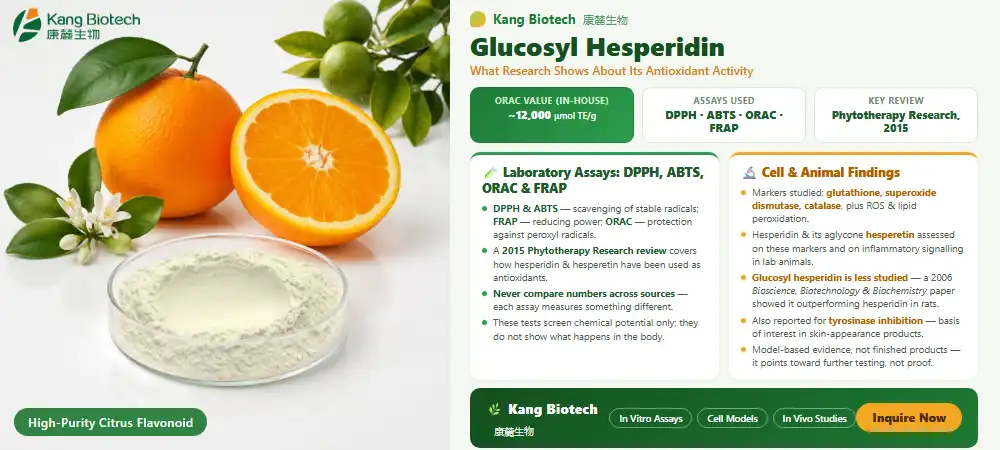
Laboratory Assays: DPPH, ABTS, ORAC, and FRAP
There are chemical tests that can be used to find antioxidants. DPPH and ABTS test how well a substance gets rid of stable radicals. FRAP tracks how much power is being used and ORAC tracks how well it is protecting against peroxyl radicals. That review, which came out in 2015 in Phytotherapy Research, talks about the different ways that hesperidin and hesperetin have been used as antioxidants. Based on facts that have already been shared, our glucosyl hesperidin powder has an ORAC value of around 12,000 μmol TE/g. I never look at numbers from different sources next to each other because they all measure different things. These tests are a good way to check out people. They don't show what happens in the body; they only show chemical potential.
Cell and Animal Findings
Scientists examine at cells and defences, such as glutathione, superoxide dismutase and catalase. They consider also reactive oxygen species and lipid peroxidation. Researchers have examined the effects of hesperidin and its aglycone, hesperetin, on these indicators and on inflammatory signalling in laboratory animals. Glucosyl hesperidin is known to some degree but not that much. It was shown to be better than hesperidin when tested on rats in a 2006 publication in Bioscience, Biotechnology and Biochemistry. It is stated about tyrosinase inhibition, which is another reason why people are interested in items that improve the appearance of skin. They are based on models, not on final things you can go and buy. They don't prove anything. They lead toward additional testing.
Absorption, Mechanisms, and Research Limits
When you ingest food, the enzymes in your stomach break down the sugar in the meal. The flavonoid is subsequently absorbed by the body where it is metabolised to metabolites. A 2006 research in The Journal of Nutrition showed healthy volunteers could use enzymatically modified hesperidin better than hesperidin itself. varying persons have varying sensitivities to these metabolites since it is contingent upon their metabolism and how much they take in. There is no evidence that glucosyl hesperidin is effective in treating or preventing illness. That requires one more review of the structure/function language before launch in the US, to make sure it adheres to the norms of the people you want to purchase from you. Also , minerals , oxygen and light may influence the efficiency of anything . Check it out after you 're done .
Glucosyl Hesperidin Solubility, Stability, and Formulation Behavior
From 0.01 to Over 50 g/100 mL
This ingredient is mostly chosen based on how well it dissolves in water. In Phytotherapy Research, a review from 2001, it is said that hesperidin does not mix well with water. Because of this, it hasn't been used in. Our glucosyl hesperidin dissolves at over 50 g/100 mL in water, while native hesperidin only dissolves at about 0.01 g/100 mL. That's a gain of around 5,000 times. Before going into the water phase, the powder doesn't need any help getting mixed up. This stops clear drinks from getting cloudy and sedimenty like regular hesperidin does. It lets a clear water phase show through in serums. We test each batch to see how well it dissolves.
pH and Heat Tolerance
The powder stays the same from pH 3.5 to 8.0. There are acidic drinks, flavored milk that is almost neutral, and a lot of skin care bases in that range. It doesn't break down below 80°C, so it can be used in many steps of mixing and making cosmetics. You should do a test run with your real time and temperature profile because some lines for making drinks hot-fill or pasteurize at or above that point. Acids, sugars, minerals, and other polyphenols can also change the color and taste of food. You should plan a small test ahead of time so that you can see how these things work with each other when the project is done.
Testing "Water-Soluble" Claims Properly
"Water-soluble" can refer to a clear liquid, a stable mixture, or a fluid that slows down over time. Any supplier should be able to tell you what tests were done to back up the claim. Tests should check for temperature, concentration, pH, mixing time, filtration, and stability after standing for a while. Check to see how well powder blends flow, how sensitive they are to water, and how evenly they mix. Check the liquids' color, taste, likelihood of precipitation, and how long they will last. A certificate of analysis (COA) is sent with every batch of glucosyl hesperidin, and you can get spec sheets, MSDS, and pesticide residue reports if you ask. You can use a bench scale to do these checks first for as little as 1 kg.
How Glucosyl Hesperidin Compares and Where It Fits


Compared with Conventional Hesperidin, Citrus Extracts, and Rutin
Most of the time, conventional hesperidin works well in capsules, tablets, and dry blends because it doesn't melt in water. Citrus bioflavonoid extracts contain many chemicals, but the mix of these chemicals changes from one batch to the next. Another flavonoid that has been studied is rutin, which can be mixed with water. It is good to use glucosyl hesperidin when you need a clear citrus flavonoid that works with water. It is only possible to compare bioavailability when doses are the same, grades are clear, and pharmacokinetic endpoints are met. Check out how the study was set up and be wary of any comparison that skips over these points.
Beverages, Dairy, and Powdered Drinks
It's clear and stable that the teams that make drinks will win. You can mix the powder with clear drinks, and it won't change how clear or thick the drink is. It can be used to make functional waters, flavored drinks, wellness shots, powdered drinks, and flavored milk. Plus it fits candy and gelatin. Tests should look at things like sedimentation, taste, acidity, mineral interactions, and shelf life. Because glucosyl hesperidin dissolves on its own, there are no additional mixing steps required. Another big company in China that makes neohesperidin dihydrochalcone (NHDC) is Kang Biotech. This means that beverage teams can get a lot of citrus ingredients from this one company.
Supplements and Skincare
The powder can be used in both soft capsules and ground-up supplements. It can also be found in vitamin P groups with vitamin C. For skin care, it's found in eye creams, brightening serums, and anti-aging items. There is published research that links it to stopping tyrosinase and periocular microcirculation. However, the claims you can make depend on the laws in your area. For cosmetics, the 90% HPLC grade should be used, and the color, pH, and interactions with preservatives should all be checked. Take your regulatory team into account right away because each market you want to reach has its own rules.
Choosing a Glucosyl Hesperidin Supplier
Documents and Quality Checks to Request
For starters, be sure you know whether the other person is a manufacturer, a distributor, or a business partner. When you get that, ask for the MSDS, the pesticide residue report, the specification sheet, the COA, and the solubility data. We check each batch for HPLC purity, heavy metals (lead, arsenic, mercury, and cadmium by ICP-MS), how well it dissolves, and whether it has more than 1,000 CFU/g of growth. Some of the certifications that our systems have are ISO 9001, ISO 22000, HACCP, Halal, Kosher, and FAMI-QS. Before you compare prices, you should look at the tests, the consistency of each batch, the lead time, and the total cost of landing.

What Kang Biotech Offers
Since 2011, Kang Biotech has been in charge of more than 20,000,000 m² of bitter orange plantations in Lianyuan, Hunan. Our 33,000 m² building has nine lines for making things. We are also in charge of a research center that our company and the Hunan Institute of Agricultural Product Processing and Quality Safety work together on. There are people from over 40 countries who buy from us. In 3–5 business days, free samples weighing 10–50 g will be sent out. Bulk orders usually take two to three weeks, but it depends on the grade and amount. For things like specs, packaging, and labels, you can pick between OEM and ODM.
A Staged Path from Sample to Launch
Take a look at the sample and paperwork, test it on a bench, build a prototype, make sure it's stable, go over the rules again, and then give the go-ahead for a pilot batch. Every step finds problems early, when they are still simple to fix. Make sure you know what the GRAS or new dietary ingredient means for the use you want to give it before you bring it to the US market. Our tech team sends the files that your regulatory advisor needs to them. You need to decide right away on the dose, serving size, pH, shelf life, and how to store the product. These will tell you if you need glucosyl hesperidin, plain hesperidin, or a citrus extract for your product.
Conclusion
An enzyme joins hesperidin and dextrin to make glucosyl hesperidin, which is a flavonoid found in citrus fruits. With an ORAC value of about 12,000 εmol TE/g, tests in the lab, on cell models, and on animals all show that it can be used as an antioxidant. This does not, however, prove that it will improve people's health. It dissolves in water in more than 50 grams per 100 milliliters, but hesperidin only dissolves in about 0.01 grams per 100 milliliters. It doesn't change when the temperature is below 80°C or when the pH level is between 3.5 and 8.0. It works well for skin care, supplements, clear drinks, and powdered drinks. On the other hand, regular hesperidin and citrus extracts work better in other ways. It's important to carefully word the claim, test the finished product, and get approval from the right authorities for the target market in order to make a sound choice.
FAQ
1. Is glucosyl hesperidin an antioxidant?
Our powder is an antioxidant, and its ORAC value is about 12,000 μmol TE/g. This was proven in the lab and on cells. These results don't show that it's helpful for patients.
2. How soluble is the powder in water?
When left out in the open, native hesperidin only dissolves at about 0.01 g/100 mL, but this one dissolves at over 50 g/100 mL.
3. Can I order a sample before a bulk purchase?
Yes, you can place an order for as little as 10–50 g or as much as 1 kg. Free samples will be sent out within 3–5 business days. It usually takes two to three weeks for large orders.
4. Does glucosyl hesperidin have US regulatory approval?
Status is based on what it's going to be used for. Make sure that your regulatory team agrees with the GRAS or new dietary ingredient position before you go live. We give you the COA, MSDS, and spec sheets to help you with that review.
5. Which grades are available?
Food grade is 75% HPLC or more. The heavy metal limits for beauty grade are stricter, and the HPLC level must be 90% or higher.
Request Glucosyl Hesperidin Samples from Kang Biotech
Want to find a business that makes glucosyl hesperidin and ships both small test batches and big orders? Kang Biotech offers free samples, ready-to-ship 75% HPLC food grade powder, and OEM/ODM service. It takes at least 1 kg to place an order. You can email sales02@kangbiotech.com with your application, the amount you want to send, and where it needs to go, or you can visit cnkangbiotech.com for more details. We'll get back to you with more information, a COA, and technical help.
References
1. Yamada M, et al. Bioavailability of glucosyl hesperidin in rats. Bioscience, Biotechnology, and Biochemistry, 2006.
2. Nielsen ILF, et al. Bioavailability is improved by enzymatic modification of the citrus flavonoid hesperidin in humans: a randomized, double-blind, crossover trial. The Journal of Nutrition, 2006.
3. Parhiz H, et al. Antioxidant and anti-inflammatory properties of the citrus flavonoids hesperidin and hesperetin: an updated review of their molecular mechanisms and experimental models. Phytotherapy Research, 2015.
4. Garg A, et al. Chemistry and pharmacology of the citrus bioflavonoid hesperidin. Phytotherapy Research, 2001.
5. Roohbakhsh A, et al. Molecular mechanisms behind the biological effects of hesperidin and hesperetin for the prevention of cancer and cardiovascular diseases. Life Sciences, 2015.
6. Kometani T, et al. Effects of alpha-glucosylhesperidin, a bioactive food material, on collagen-induced arthritis in mice and rheumatoid arthritis in humans. Immunopharmacology and Immunotoxicology, 2008.

Send Inquiry
Related Industry Knowledge
- Apigenin for Sleep: What This Chamomile Compound Does
- Glucosyl Hesperidin as an Antioxidant: What Research Shows
- Exploring Antioxidant Applications of Polymethoxy Flavonoids Powder
- Apigenin Benefits: Sleep, Anxiety, Healthy Aging, and More
- Neohesperidin Powder: Uses, Benefits and Applications
- Neohesperidin Dihydrochalcone Powder vs Stevia: Which Natural Sweetener Wins?
- The Power of Naringin
- Glucosyl Hesperidin Bulk Supplier: What Buyers Should Check
- Hesperidin: The Citrus Bioflavonoid that Supports the Brain & Heart
- Hesperidin: A Citrus Treasure with a Rich History